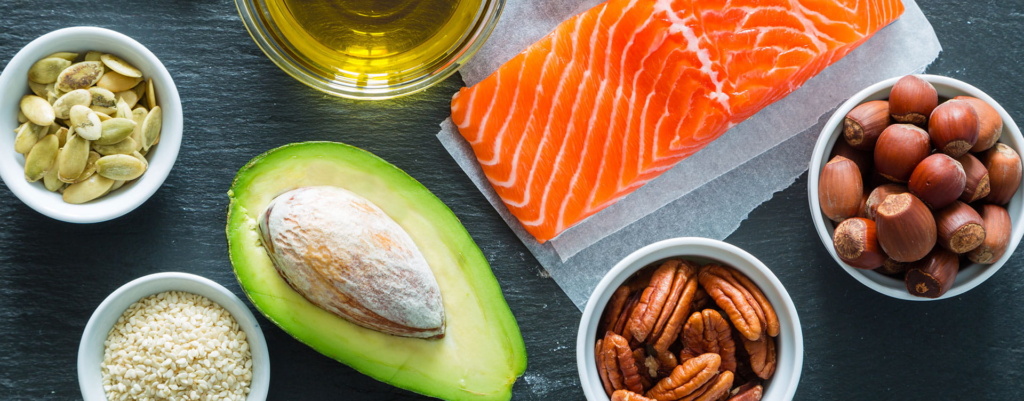
Fat Facts: The Good, the Bad and the Ugly
Discover the different types of dietary fat, their roles in the body, health effects and recommended intake.
Discover the different types of dietary fat, their roles in the body, health effects and recommended intake.
If you walk around any supermarket you are bound to see various food products proudly proclaiming to be ‘low fat’, ‘reduced fat’ or even ‘fat free’. This infers that dietary fat is inherently unhealthy and the less you consume, the better it will be for your health.
Although consuming an excessive amount of fat, or the wrong types of fat are associated with a number of health issues, fat is an essential nutrient. There are also a number of different types of fat, which each vary in their effect on health, both positively and negatively. Consequently, fats are often referred to as either ‘good’ or ‘bad’.
Therefore, in order to make informed dietary choices that support long term wellbeing, it is important to understand the distinctions between different types of fats. In this article, we explore the role of dietary fats, the various classifications of fat, their sources and potential effects on health, as well as current recommendations for fat intake.
Dietary fat is one of three essential macronutrients that play an important structural, functional and physiological role in the human body, sitting alongside protein and carbohydrates. Fat is made from chemical molecules known as triglycerides, and each triglyceride is composed of one glycerol backbone and three long chains of fatty acid. Dietary fat plays an essential role in the human body, including:
To understand how the various types of fat differ and their effects on health, we need to understand a little of their chemical structure. Although the terms ‘fats’ and ‘fatty acids’ are often used interchangeably, dietary fats are mainly composed of a mixture of triacylglycerols, also known as triglycerides as we’ve previously stated. These two terms mean exactly the same thing and are used interchangeably.
The characteristics of fats are determined by the fatty acids they contain. In short, a fatty acid is simply a long chain of carbon and hydrogen atoms.
A term often used when discussing the different types of fatty acid is ‘double bond’ (carbon-to-carbon). This double bond creates a kink or bend in the carbon chain, preventing the fatty acids from being packed tightly together. The double bonding refers to the connection between two carbon atoms where they share two pairs of electrons instead of one. This may seem a little complex, but as you read on, knowing this will help you to understand the structure of the different types of fat and why this is important.
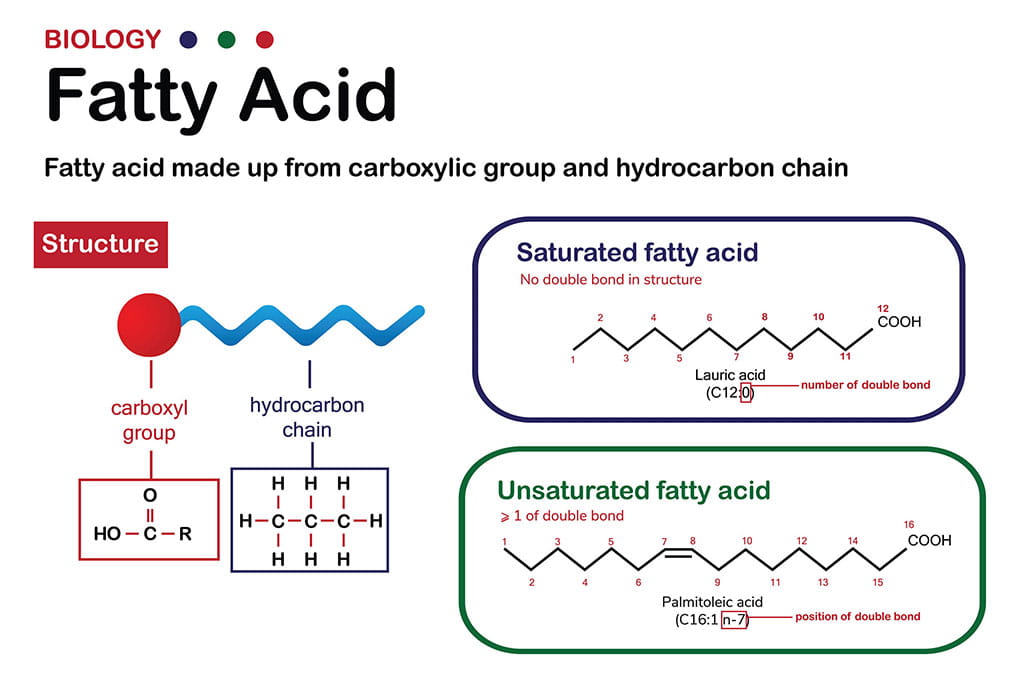
Dietary fats fall into three major categories, each with distinct chemical structures and physiological effects. These include:
Although most foods contain a mixture of these fats in varying proportions, the dominant type of fat determines their classification.
Saturated fatty acids contain no double carbon‑carbon bonds. This means that the chain is ‘full’ or ‘saturated’ with hydrogen, hence the name saturated fat. When there are no double bonds present, the fats are effectively straight and densely packed chains of fatty acids. They are packed tightly which makes them stable and more rigid in structure, which is what causes them to stay solid at room temperature (e.g., butter).
Although there is perhaps a tendency to associate saturated fat with meat and dairy, it occurs naturally in a range of animal and plant foods. These include, but are not limited to the following:
Although we need a small amount of saturated fat because it helps to maintain cell membrane structure and supports normal hormone production, an excessive intake has long been associated with an increased risk of cardiovascular disease.
It has been proposed that saturated fat can increase levels of LDL cholesterol in the bloodstream. Cholesterol is a fatty substance that is predominately made by the body in the liver. It is carried in the blood as low‑density lipoprotein (LDL) and high‑density lipoprotein (HDL).
HDL is seen as good cholesterol because it helps to transport cholesterol to the liver from parts of the body where there is an excessive amount to be disposed of. Consequently, higher HDL levels are associated with a lower risk of CVD.
LDL on the other hand is the cholesterol‑carrying lipoprotein that delivers cholesterol into artery walls, and when its level is high, it causes a build‑up of atherosclerotic plaques that narrow the lumen of the artery and increases the risk of cardiovascular disease.
A high saturated fat intake can also increase total cholesterol, and in some people raise blood triglycerides, because the liver produces more very low‑density lipoprotein (VLDL) (the triglyceride‑carrying lipoprotein). This combination of higher LDL, higher total cholesterol, and sometimes higher triglycerides, is believed to create a more atherogenic (causing atherosclerosis) blood fat profile that accelerates plaque formation.
Saturated fat has been implicated in cardiovascular disease for about 70 years. This connection dates back to the 1950s when an American physiologist, Ancel Keys, proposed the diet–heart hypothesis. Ever since, public health guidelines have recommended lower saturated fat intakes. However, the results from numerous recent studies suggest the evidence connecting CVD risk and saturated fat is weak and far more complex than originally thought.
For example, a meta‑analysis by Siri‑Tarino et al., (2) pooled 21 prospective cohort studies involving 347,747 participants that were followed for up to 23 years. This study showed no significant association between saturated fat intake and coronary heart disease, stroke, or total cardiovascular disease. The authors concluded that saturated fat itself does not appear to increase cardiovascular risk, and that the nutrient replacing saturated fat (e.g., refined carbohydrates vs. polyunsaturated fats) may be more important for heart health.
Many other studies have also examined intake of saturated dietary fat, circulating fatty acids and found no clear evidence that saturated fat intake increases coronary heart disease risk (3).
Does this mean we no longer need to limit our intake of saturated fat? No, not at all. Although this evidence suggests saturated fat may not be as problematic as previously thought, it should not be considered a green light to eat it in unlimited amounts.
This is because some of the main sources of saturated fat are unhealthy, highly processed foods with poor nutrient density. We should always aim to eat a wide variety of nutrient‑dense foods and this includes the various types of fat in the requisite amounts.
While saturated fats are straight, solid at room temperature and do not have double carbon bonds, unsaturated fats have one or more double carbon bonds that bend the hydrocarbon chain. It is this feature that helps them to stay liquid at room temperature (e.g., olive oil). Where saturated fats are said to be saturated because they have no double carbon bonds, unsaturated fats are ‘unsaturated’ because they contain one or more double carbon bonds (e.g., mono = one, poly = many).
Unsaturated fats are generally considered to be good fats because they play an important role in numerous aspects of health, particularly cardiovascular health. Unsaturated fatty acids can be classified as follows:
Monounsaturated fatty acids contain one double bond in the hydrocarbon chain (e.g., omega‑9), and are not considered to be ‘essential’ because the body can produce them.
Polyunsaturated fatty acids contain two or more double bonds in the hydrocarbon chain and the two main types of Polyunsaturated fatty acids are:
The numbers refer to the position of the first double carbon bond along the fatty acid chain. Omega 3 and omega 6 fatty acids are both considered to be ‘essential’ fatty acids because they cannot be produced by the body. They must therefore be obtained from dietary sources.
Type of fatty acid | Primary roles in the body | Key dietary sources |
Omega-3 | Reduces inflammation, supports heart and brain function | Oily fish (salmon, mackerel), flaxseed, chia, walnuts |
Omega‑6 | Supports immune function and skin health; excess can promote inflammation | Vegetable oils (sunflower, corn), nuts, seeds |
Omega‑9 | Helps improve cholesterol balance (↓ LDL, ↑ HDL) and supports metabolic health | Olive oil, avocados, almonds, cashews, peanuts |
Omega 3 fatty acids are one of the most commonly consumed supplements in the world and with good reason. There are several different types of omega‑3s, but the majority of research focuses on the following three:
Before ALA can be used for any function other than providing energy, it must be converted into DHA or EPA. The problem is that the conversion of ALA to DHA and EPA is not very efficient in humans.
In fact, the body only converts approximately 2–10% of the ALA we consume into EPA and DHA. It is for this reason that we are advised to consume approximately 200–300 mg of EPA and DHA per day (4).
The most abundant sources are found in the oils of shellfish, cold‑water herring, anchovies, sardines, mackerel, and sea mammals. In light of this, it is generally recommended that we consume two portions of fish per week to meet our EPA DHA requirements, with at least one being oily fish.
Unfortunately, the majority of the UK population does not consume enough fish, particularly oily fish. As a result, most people are not achieving the recommended intake of EPA and DHA.
While Omega‑3s have a potent anti‑inflammatory effect, omega‑6 can be pro‑inflammatory. Therefore, for good health we need to maintain an optimal ratio of omega‑6 to omega‑3 of approximately 1–4:1. However, the modern Western diet has historically had a ratio in the range of 10:1 – 20:1 (5). During the same period of imbalance there has been a significant increase in chronic inflammatory diseases. These include:
Many researchers in this space have suggested that by increasing the ratio of omega‑3s to omega‑6s in the Western diet, we may be able to reduce the incidence of these chronic debilitating and potentially life‑threatening diseases (5).
Having looked at the ‘good’ and the ‘bad’, we now turn our attention to the ‘ugly’. These are trans fats. They are called trans because of the “trans” configuration of their double bond.
This means that the hydrogen atoms are positioned on opposite sides of the double carbon bond. This straightens the fatty acid chain, making it behave more like a saturated fat (solid at room temperature) and altering how it interacts with cell membranes and enzymes within the body.
Trans fats are considered to be the unhealthiest of all of the fats. They are found primarily in partially hydrogenated oils (PHOs) that are widely used in processed foods. Partial hydrogenation is an industrial process which adds hydrogen to some of the double bonds, turning them into single bonds, which partially saturates the fat.
Common dietary sources include:
Trans fats are considered to be so dangerous to health because they:
So concerning are the effects of trans fats, that in 2015 the Food and Drug Administration (FDA) in the USA ruled that PHOs are not safe for human consumption. In the UK, major food manufacturers and retailers voluntarily removed PHOs following pressure from Public Health England and industry agreements.
As a result, UK dietary intake of industrial trans fats is extremely low (≈0.5% of energy or less), which is considerably less than the recommended maximum (6).
It is important to understand that not all trans fats are the same. Some occur naturally in small amounts in meat and dairy products. However, these ruminant trans fats are very different to industrial trans fats because they are metabolised normally by the body and do not have the same harmful LDL‑raising effects seen with industrial trans fats.
In addition, they actually provide some health benefits, such as providing anti‑inflammatory and immune‑enhancing effects.
The Scientific Advisory Committee on Nutrition (SACN) (4) provide the following guidance on fat consumption (expressed as a percentage of total daily energy intake, or TDE):
In absolute terms (i.e., grams per day), this means that women consuming around 2,000 kcal per day should aim for no more than about 70 g of total fat, while men consuming around 2,500 kcal per day should keep their total fat intake to approximately 95 g per day (4).
Although there is a tendency to think of fats as being either ‘good’ or ‘bad’, the reality is that no form of fat is inherently bad. Even trans fats can be beneficial, providing they are naturally occurring and consumed in small amounts.
On the other hand, fats perceived as inherently healthy, such as polyunsaturated omega‑6 fats, can be problematic when consumed to the point that imbalance occurs with omega‑3s.
The important thing to emphasise is not only to eat the recommended amount of fat, but also to improve the quality of the fat we consume. For example, this can be achieved by swapping saturated fats for unsaturated fats, eating sufficient portions of oily fish and choosing nuts, seeds and avocados as everyday sources of fat, which are all nutrient dense.
These simple steps can significantly reduce the risk of chronic disease while supporting optimal physiological function. Wondering why we store fat in different parts of our body compared to others? We explore the different fat storage patterns between men and women. If this article has inspired you and you think this is a career path you’d like to follow, take a look at our how to become a nutrition coach article. We also have a range of nutrition courses and qualifications you can check out.

Paul Orridge is a graduate in the field of sport, exercise and health, and has over 30 years’ experience within the fitness industry. In this time, he has performed a variety of roles including personal training, lecturing and writing. Paul now works as a freelance technical author and subject matter expert within the fitness industry. His work is based on his practical experience gained working with a diverse range of people from very unfit, overweight individuals to highly conditioned athletes, and is underpinned by the latest research.
Step inside the world of health and fitness
Great news, you're on the list...