
Ramadan is a period of time in the Islamic calendar set aside for improving mental resolve, spiritual strength, charitable actions and prayer. Put simply, Ramadan is a 4 week period of fasting requiring those who adhere to it to completely abstain from any food or water during hours of daylight.
This year Ramadan falls in spring, so while the days aren’t as long as they sometimes CAN be, they are getting longer and longer and so this extended time of abstinence can make maintaining a training regime far more difficult, though there are a number of things which need to be taken into consideration.
(Of course, as I write this we are also in a state of total lockdown which makes everything more complex. The principles outlined below still stand, however)
Now, with the rise in popularity of Intermittent Fasting (IF) I would think that it’s fairly well known at this point that fasting isn’t ALWAYS going to cause muscle loss – but just to quickly go back over old ground:
- Eating a lot of meals doesn’t increase your metabolic rate (1)
- Short-term (meaning less than 2 days) fasting doesn’t cause a starvation response and the fastest reduction in metabolic rate caused by fasting occurred at around 60 hours (2)
- You can digest a lot of protein in one sitting (3)
- It’s just not true that you simply can’t train when fasted (4). This one is especially relevant, as the study referenced was conducted on those participating in Ramadan.
So fasting isn’t the devil, but is it better? Sure, intermittent fasting has gotten some great results for some people, but it’s likely not optimal for hypertrophy due to reduced protein consumption distribution meaning a reduction in muscle protein synthesis (5,6), and up to the present moment there is no good evidence that IF does anything over and above what the same calorie deficit would do spread out more evenly.
But here we’re going a little past the point because Ramadan fasting is something entirely different to typical IF because of one major thing – you can’t drink water. As such your training needs to be planned with care.
As a final note, I want to state up front that I, myself, am an atheist. That doesn’t paint me as the ideal candidate to write this article, but bear with me. A few years ago I read reasonable amounts about the practice of Ramadan and actually took part myself, out of respectful curiosity, while house-sharing with a practising Muslim and good friend. I found it to be interesting and it allowed me to shift my focus to more important things than increasing my bench press. I also like to think I know a little about fasting and its effects on the body, so I should be of some help here.

So here are my practical recommendations for training during Ramadan:
1 – DO keep training
It’s all too easy to simply accept that you can’t train for four weeks and focus elsewhere and if you want to do that, that’s ABSOLUTELY fine, but many won’t want to simply not train for extended periods every year and so it’s to those people I’m now talking; that said you should adjust your training in a few key ways. Firstly, aim for maintenance – sure you might gain a little bit of strength in the beginner stage but this is not a time to be pushing your limits. Treat it like you were dieting hard by reducing your overall volume by around a half and doing minimal amounts of cardio.
You are going to be dehydrated as it is and the weather is warming up, so the last thing you want to do is to start doing cardio after a prolonged period without water. I also recommend you cut back to 2-3 sessions per week which is more than enough to maintain your muscle mass. In fact, you can reduce volume by around 2/3 and still maintain strength and size, so exploit it.
Focus on rep quality and taking things closer to failure rather than volume – even if training at home – and make each set count.
2- Train after Iftar (your first meal)
There are a lot of opposing viewpoints on this, but I believe that most people would do well to ensure they train DURING the eating window, and after the first meal. This allows you to elevate muscle protein synthesis before training, but more importantly it allows you to be adequately hydrated before you enter the gym. Dehydration can cause significant detriments to performance, not least of all because your body isn’t able to properly regulate its temperature.
Make Iftar a small to moderate meal, as you will be training shortly after and don’t want to throw up on your trainers…
3 – Drink calories whilst training
A simple carb drink is a good idea here to make sure you are properly fuelled, and also to help you consume sufficient calories despite a drastically reduced eating window. Of course, in a fat loss phase this can be skipped if you choose.
4 – Eat your largest meal after you train
This is where you should look to consume around 50% of your needed calories, so look for caloric density if you’re a larger guy or girl with a higher intake. During periods of fasting it’s fairly common for your stomach to shrink to compensate, and if you eat ‘clean’ you’re going to find it a lot harder than it needs to be, so don’t worry about things getting a bit more processed.
Now this isn’t me telling you to eat a bunch of junk food, but there’s no reason to avoid the delicious Luqaimat, Qatayef or any rich sauce-based dishes on offer.
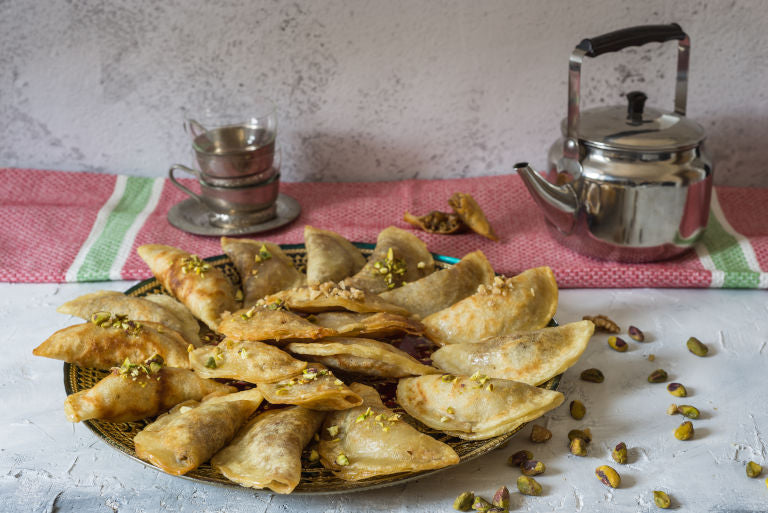
The reason to look for a huge amount of your calories here is that this is going to be your last meal before sleep, and being that you generally get precious little of that during Ramadan anyway, the food coma induced by a large meal will help you maximise your recovery time. But with that said…
5 – Sleep after your post workout meal, but wake up an hour before dawn and eat protein
After your second meal, it’s time to grab some shut-eye – but set an alarm. Waking up fully for Suhoor (your last meal before sunrise) allows you to maximise this meal as well (rather than groggily eating half a piece of toast whilst still asleep). Consume a higher protein meal – and I say this for two reasons – firstly it will keep you fuller during the day and make fasting easier, but secondly it will go some way to ensuring you have circulating amino acids in your blood for as long as possible which makes muscle loss as small a risk as can be.
6 – Sleep after your third meal for as long as you can
Again, your sleep for the month of Ramadan is going to be disturbed at best, so sleeping after your Sunrise prayer will go some way to mediating the sleep deprivation you are likely to experience. As a bonus, it’s easier to fast while you’re asleep!
7 – Nap during the day and before training
On the same lines as the above, sleep is vitally important to both training recovery, training intensity and general wellbeing – so sleeping as much as you can during the day helps to offset the sleep deficit you will create overnight. And again, a bonus is that this will make dealing with hunger a little easier.
8 – Remember what is most important
This point is probably more important than any other discussed so far. Ramadan is arguably the most important time in the Islamic calendar – its spiritual meaning is unrivalled and the potential benefits to your mindset and mental resolve cannot be ignored.
It’s also a time to spend with family, and the meals which take place between the hours of sunset and sunrise hold a very special meaning to a lot of people.

Because of this, it’s probably a time where your training should take a position far lower on the hierarchy of importance. Whether your current goals involve strength and muscle gain or fat loss, it can be considered an apt time to switch to maintenance by reducing volume and training frequency to the minimum required to keep you ticking over and have either a prolonged diet break or prolonged deload – both of which will help you in the long run anyway.
Take your foot off the gas and don’t even worry about adding weight to the bar in this time. Simply focus on maintaining what you have, and on improving your feelings of spiritual fulfilment. The progress will pick back up again as soon as you return to your regular eating and sleeping patterns.
Summary
By all means, ignore what I’m telling you and do your own thing if what you typically do works for you, but the setup I have recommended to my client and the one I practiced myself was:
- 21:30-22:00 – Iftar – 20% of daily calories
- 23:00 – 00:00 Train
- 01:00 – 01:30 Large post workout meal – 50% of calories – high carb and fat
- 01:45 – 04:00 – Sleep
- 04:15 – 04:40 – Suhoor – 30% of calories, high protein
- 05:00 – 09:00 – Sleep
- 17:00 – 19:00 – Sleep
I hope this has helped. Have a great month.
References
- Bellisle F et. al. Meal frequency and energy balance. Br J Nutr. (1997) 77 (Suppl 1):S57-70
- Nair, K., Woolf, P., Welle, S. and Matthews, D., 1987. Leucine, glucose, and energy metabolism after 3 days of fasting in healthy human subjects. The American Journal of Clinical Nutrition, 46(4), pp.557-562.
- Arnal, M., Mosoni, L., Boirie, Y., Houlier, M., Morin, L., Verdier, E., Ritz, P., Antoine, J., Prugnaud, J., Beaufrère, B. and Mirand, P., 2000. Protein Feeding Pattern Does Not Affect Protein Retention in Young Women. The Journal of Nutrition, 130(7), pp.1700-1704.
- Chaouachi, A., Coutts, A., Chamari, K., Wong, D., Chaouachi, M., Chtara, M., Roky, R. and Amri, M., 2009. Effect of Ramadan Intermittent Fasting on Aerobic and Anaerobic Performance and Perception of Fatigue in Male Elite Judo Athletes. Journal of Strength and Conditioning Research, 23(9), pp.2702-2709.
- Areta, J., Burke, L., Ross, M., Camera, D., West, D., Broad, E., Jeacocke, N., Moore, D., Stellingwerff, T., Phillips, S., Hawley, J. and Coffey, V. (2013). Timing and distribution of protein ingestion during prolonged recovery from resistance exercise alters myofibrillar protein synthesis. The Journal of Physiology, 591(9), pp.2319-2331.
- Layman, D., Anthony, T., Rasmussen, B., Adams, S., Lynch, C., Brinkworth, G. and Davis, T. (2015). Defining meal requirements for protein to optimize metabolic roles of amino acids. American Journal of Clinical Nutrition, 101(6), pp.1330S-1338S.
- Bickel, CS, Cross, JM, and Bamman, MM. Exercise dosing to retain resistance training adaptations in young and older adults. Med Sci Sports Exerc 43: 1177-1187, 2011
Author
Ben Coomber
Founder of Awesome Supplements
Ben Coomber is a nutritionist (BSc, CISSN), educator, speaker and writer. Ben has the UK’s #1 rated health and fitness podcast on iTunes ‘Ben Coomber Radio’ and he's the founder of Awesome Supplements.
Subscribe to our newsletter
Step inside the world of health and fitness
Great news, you're on the list...