
Tell me I’m not allowed to eat cookies… and I’m going to eat a cookie.
I might manage to resist for a while but eventually I’ll crack
And when I do I’ll probably end up eating a whole pack because mentally I will have failed my diet so might as well go all out. Sound familiar?

Sure, the odd indulgence here and there isn’t the end of the world and a few hundred Calories won’t ruin your fat loss progress IF you maintain a decent Calorie deficit over a prolonged period of time.
But when this ‘cheating’ cycle happens on a consistent basis and one innocent cookie leads to two which then leads to a 16 inch pizza, 2 tubs of Ben and Jerrys along with a side of donuts, that sure can put a dent in your progress (see graph below).
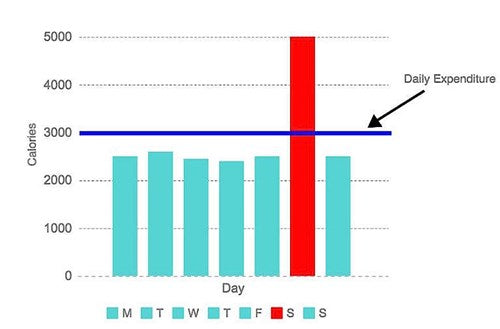
And more importantly it may impact you mentally.
Why is this?
Lack of flexibility often leads to a black and white approach to dieting where you’re either on or off your diet (5). This means that when certain restricted foods are eaten, it’s quite likely your diet is forgotten and full on ‘cheat’ mode ensues where anything and everything goes.
When certain foods are restricted, they’re also likely to take up more of your headspace, which again may lead to massive ‘cheats’ when your will power eventually fails you. In actual fact, it’s quite likely that by allowing yourself these foods in moderation you’ll find you don’t even want them all that bad anyway and feel less of a need to ‘cheat’ on your diet.
That plus the fact you’ll most likely enjoy your diet more by being flexible means you’ll have greater adherence to your diet, which will have a domino effect of improving your fat loss results as consistency breeds success.
So eating some cake, ice cream or cookies may help you shed fat.
However, this is where flexible dieting often gets misunderstood and has lead to the BIG misconception that flexible dieting = eating ‘junk’ food all day long.
Misconception 1: Flexible dieting = eating ‘junk’ food all day long
Whilst some might take this approach, the majority of sensible Flexible Dieters understand that it’s not all about ice cream and cookies but a balance needs to be struck with minimally processed nutritious foods making up the vast majority of the diet. We all know that these foods will keep us feeling fuller for longer, help maintain energy levels and are vital for general health and well-being.
So in the words of Dan Jon, “eat like an adult” and make sure most of your diet (>80% of Calories) is nutritious and minimally processed foods. Provided you nail this, there’s no harm in including some not so nutritious foods you love the taste of IF you fancy them and provided you’re not allergic/intolerant to any ingredients. As I’ve explained, this will make your diet more enjoyable and may help you stick to it long term. Alan Aragon suggests allowing up to 20% of your Calories for less nutrition foods.
I will add that this is with the caveat that:
- You can identify and manage your trigger foods. Yes, eating ice cream and cookies in moderation is great but sometimes moderation just isn’t possible because some foods are too damn tasty. Any food you’re unable to eat in moderation is a trigger food. Identify your trigger foods and either cut them out your diet except for special occasions or find a way to manage your intake of them. For example I only buy small 200-300kcal tubs of ice cream as if I start a larger tub, I invariably have to finish it
- You are eating in line with your goals. This is an obvious point and means taking in fewer Calories than you expend for fat loss or a slight surplus for muscle gain. You should also be at least mindful of your macros (protein, carbs and fat) if you want the best results
On that note, I’m going to expand on another misconception many seem to have about flexible dieting which is that is that it is synonymous with macro tracking.
Misconception 2: Flexible dieting is synonymous with macro tracking
It’s not. Flexible dieting is an overarching mind-set and macro tracking is merely one method of controlling your diet in line with your goals. So find a method that suits both your preferences and goals whilst applying the above points. Some of the most common methods include:
Macro tracking:
Once you’ve determined your macro requirements (protein, fat, carbs) just aim to hit them as best you can within a certain range. If you hit your macros, you’ll hit your Calorie target by default.
Protein and calorie tracking:
Hit a protein target and let your carbs and fat make up the rest of your Calories without focusing on specific intakes of each.
Calorie tracking:
Like macro tracking, this is pretty self-explanatory. Aim to hit your Calorie target as best you can within a certain range.
Portion control:
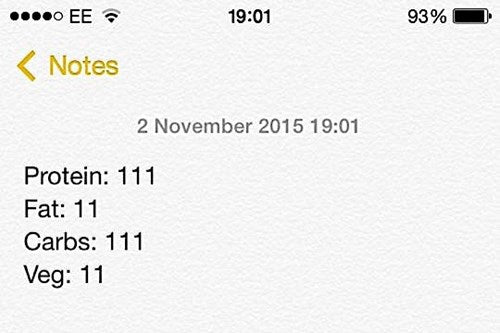
There’s different ways to approach this method. You could go for a set number of portions per meal (eg: 1 fist protein, 1 fist carbs, 1 thumb fat, 1 fist veg) or like macro tracking, you could set yourself a number of portions of carb, fat and protein dense foods for the day and just tally them up on your phone like this:
Ad libitum/Mindful eating:
Focus on sticking to consistent eating patterns and aim to eat roughly the amount of food to stay in line with your goals. This is most effective for people who already have a decent grasp on nutrition and portion sizing OR those who are combining it with dietary rules such as low carb, intermittent fasting or specific dietary habits.
This is by no means an exhaustive list and there are so many other approaches you can take to your diet. Just make sure that whatever approach you choose incorporates points I’ve highlighted under “Misconception 1”.
The scale of precision
You also don’t have to stick to a particular method the whole time though and can be flexible with the one you apply based on your goal and the situation you’re in. A good way to go about this is to picture the methods I outlined above as lying somewhere on a precision spectrum (6). You can move up and down on this precision spectrum depending on: [1] where you are on your nutrition journey and [2] based the occasion/situation you find yourself in.
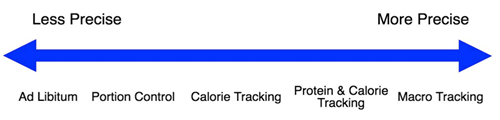
1. Applying the precision spectrum to where you are on your nutrition journey
For example you may have an upcoming photo-shoot to prep for so decide a more precise approach such as macro tracking is necessary for the best part of 3-4 months. Once you’ve nailed your prep and had the photo-shoot, instead of continuing to stick to macros you may switch to tracking just Calories and protein or you may decide to transition into an ad libitum approach.
2. Applying the precision spectrum to the situation you’re in
Using the same example, during your photo-shoot prep you’re likely to have the odd occasion where you end up going out for a meal with friends or family and in these situations you may not fancy tracking macros. When you previously might have though “ahhh screw it” and gone off track because you weren’t controlling your intake as strictly as normal, you could simply be flexible and change your approach to a less precise method for the occasion by eyeballing portion sizes as best you can or estimating your Calorie intake.
These concepts Eric Helms explains in his recent book “Muscle & Strength Nutrition Pyramid” (6). He describes a 3-tiered system to macro/Calorie tracking whereby at tier 1 you aim to hit your macros within a defined range (+- 5-20g depending on how precise your goal requires you to be) but if you decide to use tiers 2 or 3 you’re less strict and aim to hit your protein and Calorie target or just your Calorie target.
Eric also highlights that the proportion of you time spent using any particular method will depend on your goal. For example, you should make sure you’re tracking macros for the vast majority of the time if you’re prepping for a physique show (e.g., around 6 days out of 7) and use a narrow range Calorie or Calorie and protein based approach for the remainder. This will also change depending on your proximity to the show as the closer and leaner you get, the less room you’ll have for error. Conversely, if you can’t see your abs yet and aren’t prepping for a show, you don’t need to be quite so strict with your approach.
I’ll add that you should strive for consistency regardless of your goal and a practical guideline to go by is sticking to one primary approach for at least 5 days of the week (or >65% of the time) with the option of using a less precise approach for the other days. Eric goes into much more detail on all this and his books are definitely worth a read.
Take home
To sum up, flexible dieting is great; it gives you the freedom to enjoy your favourite foods without the feelings of guilt and without compromising your progress. It is not fitting as much ice cream and cookies into your diet though and tracking macros is not the only approach you can take to reach your goals. Rather, it’s about having a flexible mind-set and using your understanding of nutrition to make appropriate dietary choices.
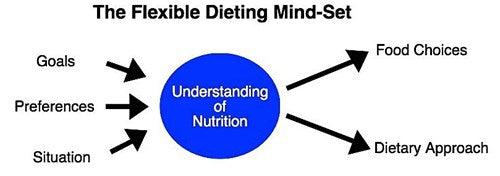
This ability to be flexible not only with your food choices but also on the dietary approach you use allows you to maintain some form of control and keep on track at times where you otherwise might have gone way off the rails.
So should you eat the cookie?
It depends and there is no black and white answer.
- Are you free from allergies/intolerances to the cookie ingredients?
- Is your diet nutritious on the whole?
- Will it fit in line with your goals and nutrition approach (eg: Calorie/macro requirements)?
- Do you fancy a cookie?
- Will you be able to stop at one or two?
If the answer to these questions is yes, then there’s no reason not to.
If you enjoyed this article and want to take your knowledge further, take a look at our Nutrition for Health and Weight Management course. This programme is ideal for exercise professionals looking to add real value for clients through practical, evidence-based nutrition coaching. Alternatively, you can also read more in our collection of nutrition articles.
References
- Hall, K. D., Heymsfield, S. B., Kemnitz, J. W., Klein, S., Schoeller, D. A., and Speakman, J. R. (2012). Energy balance and its components: implications for body weight regulation. The American journal of clinical nutrition, 95(4), 989-994
- Timko, C. A., and Perone, J. (2005). Rigid and flexible control of eating behavior in a college population. Eating behaviors, 6(2), 119-125
- Sairanen, E., Lappalainen, R., Lapveteläinen, A., Tolvanen, A., and Karhunen, L. (2014). Flexibility in weight management. Eating behaviors, 15(2), 218-224
- Stewart, T. M., Williamson, D. A., and White, M. A. (2002). Rigid vs. flexible dieting: association with eating disorder symptoms in nonobese women. Appetite, 38(1), 39-44
- Westenhoefer, J. (1991). Dietary restraint and disinhibition: is restraint a homogeneous construct?. Appetite, 16(1), 45-55
- Helms, E., (2016). The Muscle and Strength Pyramids
Author

Ben Coomber
Founder of Awesome Supplements
Ben Coomber is a nutritionist (BSc, CISSN), educator, speaker and writer. Ben has the UK’s #1 rated health and fitness podcast on iTunes ‘Ben Coomber Radio’ and he's the founder of Awesome Supplements.
Subscribe to our newsletter
Step inside the world of health and fitness
Great news, you're on the list...