How should women train for strength?
Discover what the latest evidence says about how women should train for strength and how to programme resistance training for women.
Discover what the latest evidence says about how women should train for strength and how to programme resistance training for women.
For centuries, women have been actively discouraged from strength training for a multitude of reasons: it was unfeminine, dangerous, or incompatible with women’s biology.
Thankfully, we now live in more enlightened times and the benefits of strength training for women, both in terms of health and performance, but also aesthetic reasons, are well-established. Since the physiological characteristics of muscle tissue are the same in men and women, the basic principles of strength training apply equally to both sexes.
That said, this does not mean that there aren’t sex-specific physiological differences that influence how women respond to resistance training. There are, but these differences do not require a fundamentally different training approach. They do, however, influence the optimal programming variables like volume, recovery, and, for some women, menstrual cycle–related adjustments.
In this article, we will explore the physiological differences between men and women and how these influence women’s response to, and adaptation from, strength training. We will also outline how personal trainers can use this information to optimise training programmes for their female clients.
Broadly speaking, women typically possess a greater proportion of Type I (slow twitch) muscle fibres than men, particularly in the lower body musculature. Although Type I fibres produce less force than their Type II (fast twitch) counterparts, they are more resistant to fatigue and recover more quickly between bouts of work (1). This enables women to perform greater repetitions at a given percentage of their 1 repetition maximum (1RM). They also tend to recover more quickly between sets (2).
It is important to emphasise that this does not mean women possess greater strength; rather, they have a different fatigue profile that can influence programming.
Practical implications for personal trainers
The differences in fibre type and resistance to fatigue mean female clients may:
Women possess higher levels of the steroid hormone oestrogen. This has a protective effect on muscle tissue by reducing inflammation and muscle damage following eccentric exercise and enhancing satellite cell activation.
Satellite cells are the muscle’s resident stem cells (3). When activated, they repair damaged fibres, support hypertrophy, enable adaptation to training, and maintain long-term muscle health. They also help preserve fibre quality, mitochondrial function, and the ability to adapt to training over time.
Consequently, women tend to experience lower creatine kinase (a marker of muscle damage/stress) responses post-training, reduced delayed onset muscle soreness (DOMS), and faster recovery between sessions.
Practical implications for personal trainers
Higher oestrogen levels mean that female clients may:
Although women have lower testosterone levels than men, they achieve similar relative hypertrophy (percentage improvement) gains when training at equivalent intensities.
A 2021 meta-analysis by Roberts et al. (4) found no sex difference in percentage hypertrophy gains when training variables were matched. This includes rate of growth and fibre type hypertrophy. However, upper-body hypertrophy does tend to be slower.
While men’s hypertrophy is driven predominately by testosterone, women’s hypertrophy results more from other hormones, especially the actions of growth hormone, IGF-1, and oestrogen-mediated anabolic signalling.
Practical implications for personal trainers
Despite the differences in hormonal status, female clients:
Strength gains
Like hypertrophy, men typically achieve greater absolute strength gains due to higher testosterone levels, larger baseline muscle mass, and greater Type II muscle fibre composition which has a greater cross-sectional area (they are larger in size). However, women’s relative strength gains are equivalent when training is matched. When strength is expressed per unit of muscle, any differences begin to disappear (4).
Practical implications for personal trainers
As with hypertrophy training, female clients:
Although men often produce higher absolute power outputs due to their greater overall muscle mass, higher composition of Type II muscle fibres, and higher baseline neuromuscular drive, women’s relative improvements and the shape of the force–velocity curve are also similar when training variables are matched.
The primary determinant of maximal power expression has been shown to be training status, not sex (5). When it comes to power training, women may have an advantage as their faster recovery between sets allows them to maintain higher quality across repeated explosive efforts.
Practical implications for personal trainers
As women respond effectively to standard power training methods, they do not require different intensity or velocity prescriptions to develop power but may benefit from:
● More emphasis on technical proficiency to maximise force–velocity transfer
● Greater focus on neuromuscular control
● Slightly higher frequency of plyometric exposure
● More gradual progression due to lower initial power
● Greater emphasis placed on technical proficiency to maximise force–velocity transfer
Women typically possess greater relative strength in the lower body than the upper body and achieve faster strength gains in lower-body exercises.
This should be considered when developing strength training programmes for female clients, as studies have found that women benefit from 2× weekly lower-body training sessions and 2–3× weekly upper-body training sessions for optimal strength development (6).
Practical implications for personal trainers.
When prescribing strength training for female clients:
Women often demonstrate greater quadriceps dominance, lower hamstring activation during landing and cutting tasks, and higher knee valgus angles (i.e., knee collapses inward during movements such as landing, squatting, or running) (8). This is at least in part because they have a wider q-angle (the angle between ilium bone and patella tendon). In men, this is typically around 15%, whereas in women it’s around 18% on average.
These factors contribute to the higher incidence of ACL injury in women, with neuromuscular control deficits identified as a primary contributor (8).
Practical implications for personal trainers
Although the following considerations are more sport-specific, rather than general resistance training considerations, some female clients may benefit from:
The menstrual cycle accounts for a profound difference between males and females and this is something that can impact a woman’s strength training performance considerably.
Although responses vary between individuals, research suggests that fluctuations in ovarian hormones across the menstrual cycle can significantly influence strength, fatigue, recovery, and perceived exertion.
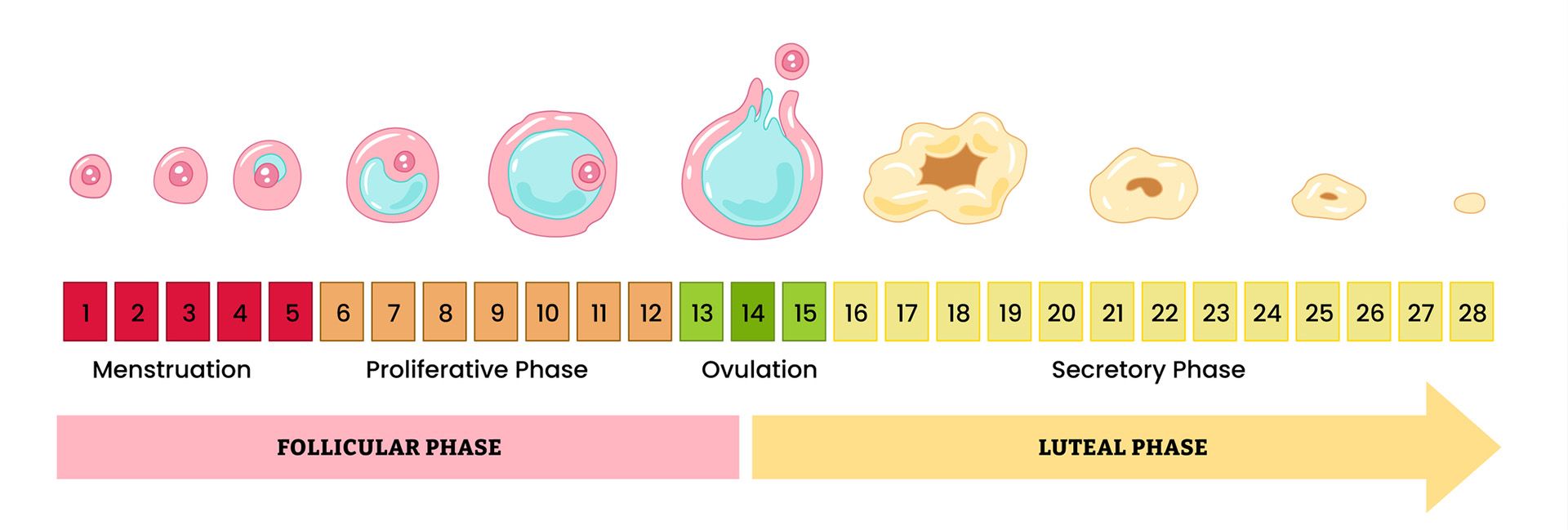
During the follicular phase (days 1–14) of the menstrual cycle, rising oestrogen levels are associated with:
A number of studies have shown that maximal strength, power output, and training responsiveness can all increase during this phase. This makes it a potentially productive time for higher-load or higher-volume strength training (11).
This contrasts with the luteal phase (15–28) of the menstrual cycle, which is characterised by elevated progesterone. The effects of which may include:
Some women report reduced strength performance and greater discomfort during this phase. For these individuals, slightly reduced training volume, increased recovery periods, or a shift towards more technical work with moderate loads, or lower-impact conditioning may be beneficial (12).
It is important to note that not all women experience predictable or significant reductions in performance. Consequently, the National Strength and Conditioning Association (NSCA) recommends that menstrual cycle–based programming should be individualised (7) based on the client or athlete’s response to training.
Monitoring symptoms, training responses, adaptations and recovery across multiple cycles is considered to be a more effective strategy than applying general rules and adaptations to training at different stages of the menstrual cycle.
When constructing strength training programmes for female clients, it is important to remember the following:
*Personal trainers coaching female clients around specific stages of the menstrual cycle should undertake extensive research, ideally completing specific female fitness coaching courses, perinatal exercise instructor training, and/or an industry-recognised menopause fitness instructor course. All of these qualifications will present evidence-based content that delves deeper into the female cycle and how this affects exercise capacity, tolerance and adaptation.
The evidence clearly shows that your female clients do not require a fundamentally different approach to resistance training than male clients. The key principles of training, such as progressive overload and specificity apply as much to women as they do to men.
However, specific physiological differences between the sexes can influence optimal programming variables, such as training volume, recovery, fatigue resistance, and, for some women, menstrual symptoms.
These differences are best accommodated by taking an individualised approach with clients, recognising nuances and specific circumstances, and making adjustments based on where the client is at and what their needs are at that time.
Adhering to the well-established principles of strength training should be the mainstay of any approach, with detours and deviations only being made as and when they are required.
If you’d like to deepen your understanding of interesting topics like this, or you would like to learn more about exercise physiology, programming, and how to coach clients in a gym or other training environment, take a look at our range of personal training courses. Whether you’re just starting out and you want to expand your own knowledge, or you’re keen to change career and become a qualified fitness professional, our industry-leading qualifications are evidence-based and delivered by some of the most experienced and qualified trainers in the business. That’s why we have the reputation we have as the best training provider for personal training education.
1) Nuzzo JL. Sex differences in skeletal muscle fiber types: A meta-analysis. Clin Anat. 2024 Jan;37(1):81-91. doi: 10.1002/ca.24091. Epub 2023 Jul 10. PMID: 37424380.
2) Hunter SK. Sex differences in fatigability of dynamic contractions. Exp Physiol. 2014;99(2):193–199.
3) Enns DL, Tiidus PM. The influence of estrogen on skeletal muscle: sex matters. Sports Med. 2010;40(1):41–58.
4) Roberts BM, Haun CT, Vann CG, et al. Sex differences in resistance training induced muscle hypertrophy: a systematic review and meta analysis. Sports Med. 2021;51(10):2249–2276.
5) Miller R, Freitas E, Heishman A, Kaur J, Koziol K, Galletti B et al. Maximal power production as a function of sex and training status. Biology of Sport. 2019;36(1):31-37. doi:10.5114/biolsport.2018.78904.
6) Grgic J, Schoenfeld BJ, Mikulic P. Optimal resistance training frequency for women: a systematic review. PLoS One. 2023;18(4):e0283457.
7) National Strength and Conditioning Association (NSCA). Position statement on resistance training for female athletes. J Strength Cond Res. 2021;35(11):3179–3198.
8) Hewett TE, Myer GD, Ford KR. Understanding and preventing ACL injuries in women. Br J Sports Med. 2006;40(5):368–372.
9) Wikström Frisén L, Boraxbekk CJ, Henriksson Larsén K. Effects of menstrual cycle phase on strength training adaptations in resistance trained women. J Strength Cond Res. 2017;31(6):1611–1618.
10) Sung E, Han A, Hinrichs T, Vorgerd M, Manchado C, Platen P. Effects of follicular versus luteal phase based strength training in young women. Int J Sports Med. 2014;35(9):709–715.
11) Janse de Jonge XAK. Effects of the menstrual cycle on exercise performance. Sports Med. 2003;33(11):833–851.
12) Blagrove RC, Brown N, Howatson G. Sex differences and menstrual cycle influences on neuromuscular performance. Eur J Appl Physiol. 2020;120(10):2607–2620.

Paul Orridge is a graduate in the field of sport, exercise and health, and has over 30 years’ experience within the fitness industry. In this time, he has performed a variety of roles including personal training, lecturing and writing. Paul now works as a freelance technical author and subject matter expert within the fitness industry. His work is based on his practical experience gained working with a diverse range of people from very unfit, overweight individuals to highly conditioned athletes, and is underpinned by the latest research.
And get the fast-paced world of personal training delivered straight to your inbox every week
Great news, you're on the list...