Exploring Classical Pilates.
In this article we will explore the rich history and context of the most authentic style of Pilates - the classical work.
In this article we will explore the rich history and context of the most authentic style of Pilates - the classical work.
As the popularity of Pilates continues to grow, there is an increasing curiosity about the history of Pilates and the origins of the system. This is what is known as ‘Classical’ Pilates, but it may also be known as ‘Authentic’ Pilates.
In this article, we will define and explore Classical Pilates and explain how it differs from other more contemporary approaches of the method, especially those which are more widely available in the health and fitness sector. We have opted to provide additional information and supporting references throughout for those who are interested in exploring this subject further. We also have a separate article dedicated to contemporary styles of Pilates, which you may also find useful and interesting.
In the UK, when the term Classical Pilates is used, it is often incorrectly associated with the original 34 matwork exercises published in Joseph Pilates’ 1945 book ‘Return to Life Through Contrology’.
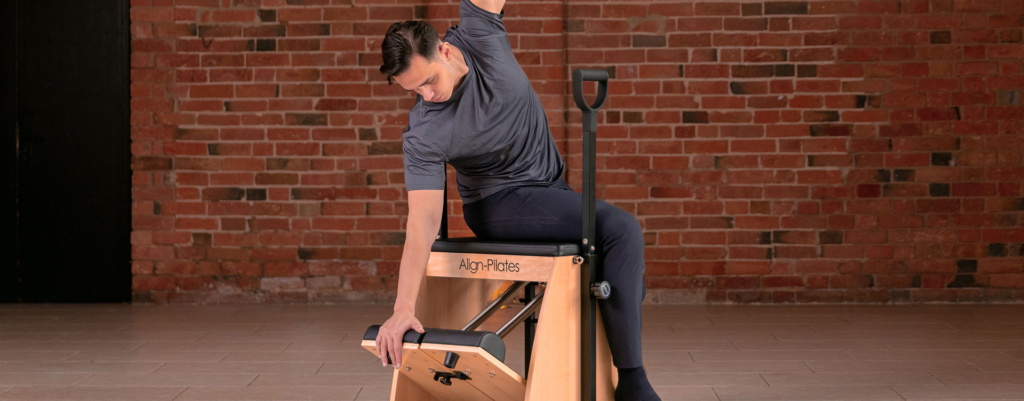
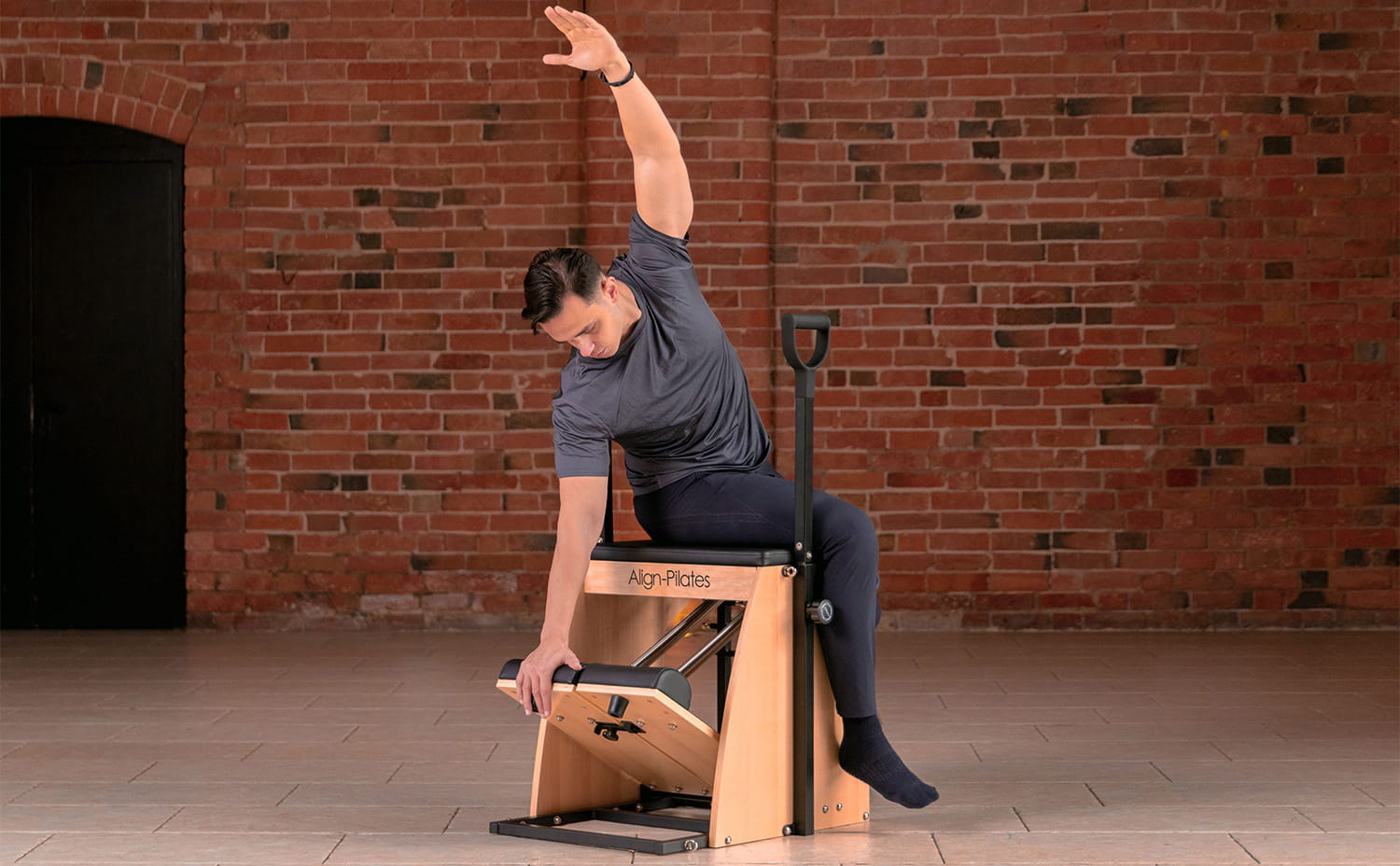
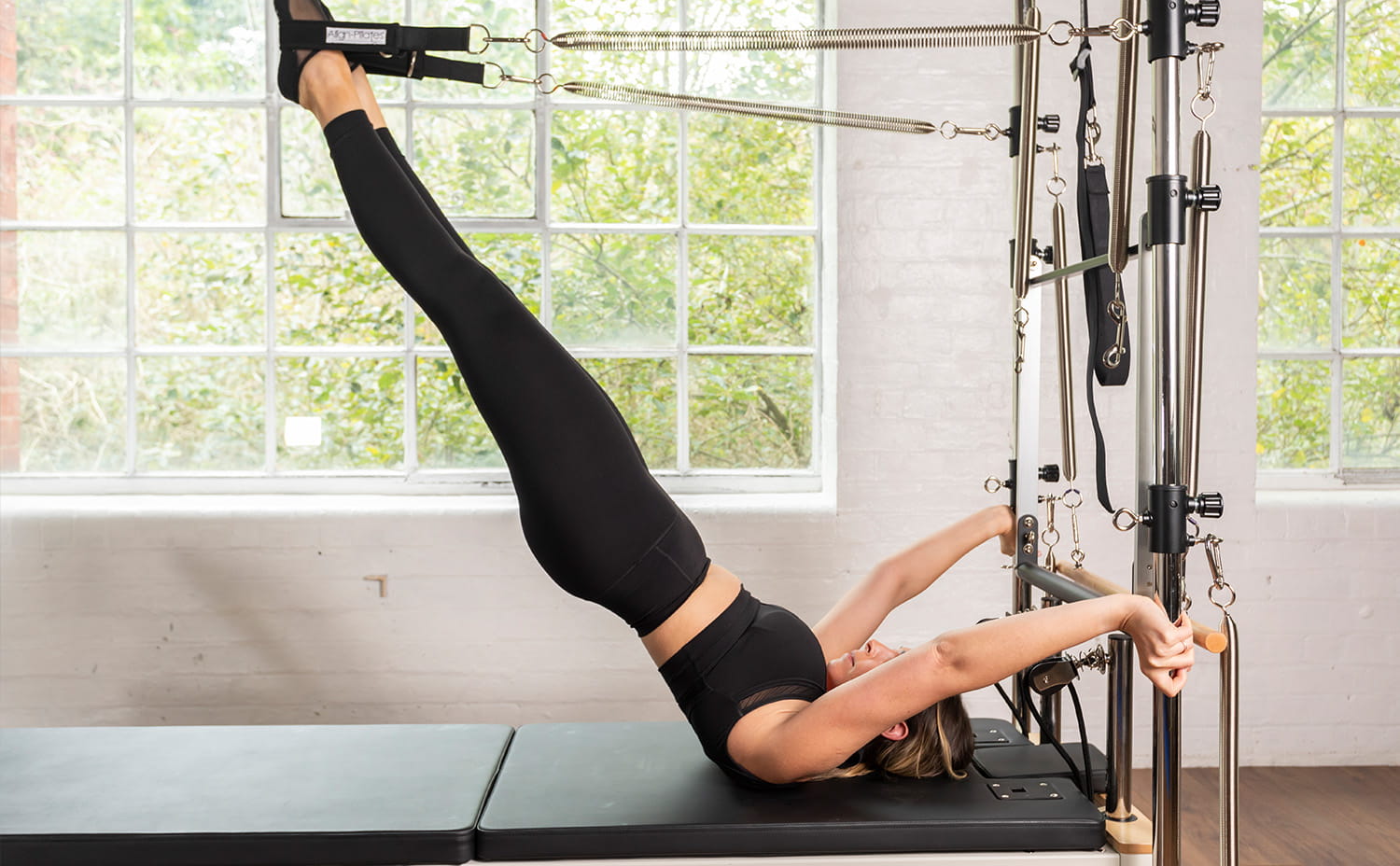
However, Classical Pilates is much broader in scope than the mat-based exercises. In fact, it’s a full system of exercises that work across the whole range of Pilates equipment, which in Pilates is referred to as apparatus (e.g., reformer, chairs, barrels, Cadillac).
Mat-based Pilates exercises are the smallest and hardest component of the wider system and are seen by many as the pinnacle of the method and the ultimate goal or target to work towards.
Teachers who are trained to use the full suite of Pilates apparatus are described as being ‘fully comprehensively trained’. A fully comprehensive teacher will typically use different pieces of apparatus within a single session to support their client’s individual needs.
Classical Pilates is the system of exercises taught by Joseph Pilates and his wife Clara to the clients attending their New York studio (1926 – 1977). Originally named ‘Contrology’, this system involved working on the mat (the 34 exercises published in the book ‘Return to Life Through Contrology’), work on the reformer, and work using other bespoke apparatus designed by Joseph Pilates to support the individual needs of his clients, many of whom were professional dancers and performers. Such apparatus included the Cadillac, Electric Chair, Wunda Chair, Baby Chair, Guillotine, Spine Corrector, Ladder Barrel, Foot Corrector and many more.
This classical approach is very different from some of the exercises and sessions we see in Pilates today, not least because only parts of the system are delivered (e.g., matwork, reformer), and rarely in full.
It is reported anecdotally that the model of delivery employed in the New York studio required each person to be taught by Joe a programme of exercises and they were expected to be able to follow that programme independently, receiving occasional support from Joe, Clara and other assistants as required (Howard Steel, 2020).
This delivery model is quite different from how Pilates is instructed in many health clubs, Pilates studios and leisure centres today. Nowadays, sessions are usually delivered to mixed-ability groups or as one-to-one sessions and with much greater variety. The classical format is more consistent with what happens in modern gyms, whereby each client has their own programme card, they learn it, practise it and receive supervision when they need it.
One key difference between Classical Pilates and gym-based exercise is that with Classical Pilates, a specific system and order of exercises are followed. Now, this doesn’t mean every individual does every single exercise in a regimented or pre-defined fashion (there are over 500 exercises in the full system). On occasions, exercises may be excluded, sometimes modified, but what was more likely to happen is that clients would be taken to work on other apparatus to build specific skills and competencies, according to their physical and functional needs. This is the classical system and the most comprehensive way of teaching Pilates.
In Classical Pilates, it is not about targeting specific muscles. Instead, the system is used to improve and move the body to a more advanced level. It is using highly controlled movements, enjoying the length, strength and stretch in every exercise.
To illustrate this point practically, we have provided two applied examples of how this concept translates to the classical way of teaching Pilates.
If a client were performing the leg series, side kick kneeling, or side splits on the reformer in a way that was less than efficient or controlled, instead of labelling the hip abductors and adductors as being ‘weak’, the teacher would simply take the client to a more supportive exercise that develops those deficits, like ‘going up front’ on the Electric Chair, which has heavier springs and provides the body with greater support. A good Pilates teacher would observe the whole body, how it is moving (i.e., sinking through waist, not being able to keep alignment, not being strong enough to control the movement, unable to keep the abdominal connection) and will be able to support their client to achieve their goal of ‘returning to life’ by using all that the system has to offer. This is the very essence of Classical
If a client is able to roll like a ball but loses the connections in the seal exercise, the teacher may look to work with the client using ‘the hug’ on the reformer, Cadillac or even better, the Baby Chair, where the soles of the feet are placed together in order to get the desired connection. In fact, a true classically trained teacher will know if their client isn’t ready for the seal and will begin preparing their client for this exercise with other parts of the system and using other apparatus.
History tells us that Joseph Pilates always taught the person in front of him according to their individual needs and abilities. Therefore, any specific exercises chosen or particular apparatus used, would always be different for each client. That said, there was always an exercise order and intention behind his programming.
Pilates was never intended to be a series of random exercises thrown together to create variety. As we’ve previously illustrated, it was intended to be an integrated system where all of the tools available could be used to enhance the movement capabilities of the client. The pinnacle of this system is the ability to perform the matwork exercises competently, in a flowing sequence for the prescribed number of repetitions. The apparatus is merely intended to support the individual on their journey as they work towards that goal.
As Alisa Wyatt (Pilatesology, 2026) explains:
‘The classical order is like a home base. It gives you something steady to return to, whether you’re teaching, practicing, or just trying to reconnect with the work in a more meaningful way.
Over time, it becomes less about memorising exercises and more about understanding how everything fits together. You start to notice the transitions, the relationships between movements, and the way one exercise sets you up for the next.
The more time you spend with it, the more you begin to appreciate just how intentional it all is. The sequence isn’t just a list, it’s a system! One that Joseph Pilates built to support the body as a whole, and one that continues to reveal more the deeper you go’.
A major distinguishing and differentiating feature of the Classical Pilates approach is lineage. Lineage is like a family tree, and describes an individual’s direct descent from their ancestors. In Classical Pilates, these ancestors are considered to be the elders.
Lineage to the elders is something that matters a great deal in classical circles. Those who are passionate about Classical Pilates aim to get as close as they can to the original source, with some teachers completing multiple training courses and workshops to achieve this.
The Pilates elders are the first generation of teachers who were taught, trained, and apprenticed directly by Joseph and Clara Pilates in the original New York Pilates Studio. Many of the elders have now sadly passed, but they include Carola Trier, Eve Gentry, Kathy Grant, Romana Kryzanowska, Ron Fletcher, Mary Bowen, and Lolita San Miguel.
Joseph Pilates never created a formal teacher-training curriculum and never officially published how the full Contrology system should be taught. Each elder learned experientially, first as a client (usually for many years) and only when they were ready were they invited to assist with teaching in the studio. While working in the studio, they served as apprentices under the direct supervision and guidance of Joseph, Clara, and other senior apprentices, such as Hannah Sakamirda, John Winters and Mary Pilates (Joseph’s niece).
In the absence of formal teaching documents, much of what we understand about Pilates today is that which has been passed down by the elders. Given that each elder would have had their own programme created for their own individual needs, they would each have their own unique experience of the Pilates system. This is likely to have significantly influenced how they understood and interpreted the work, and equally, how they subsequently passed this forward to future generations in their teachings. In the book ‘Voices of Classical Pilates’ (Fiasca et al., 2013), many well-respected classical teachers share their experiences.
It’s important to highlight here that even amongst the Classical Pilates schools, there is much diversity and difference of opinion on some subjects. This is also true in just about any other profession.
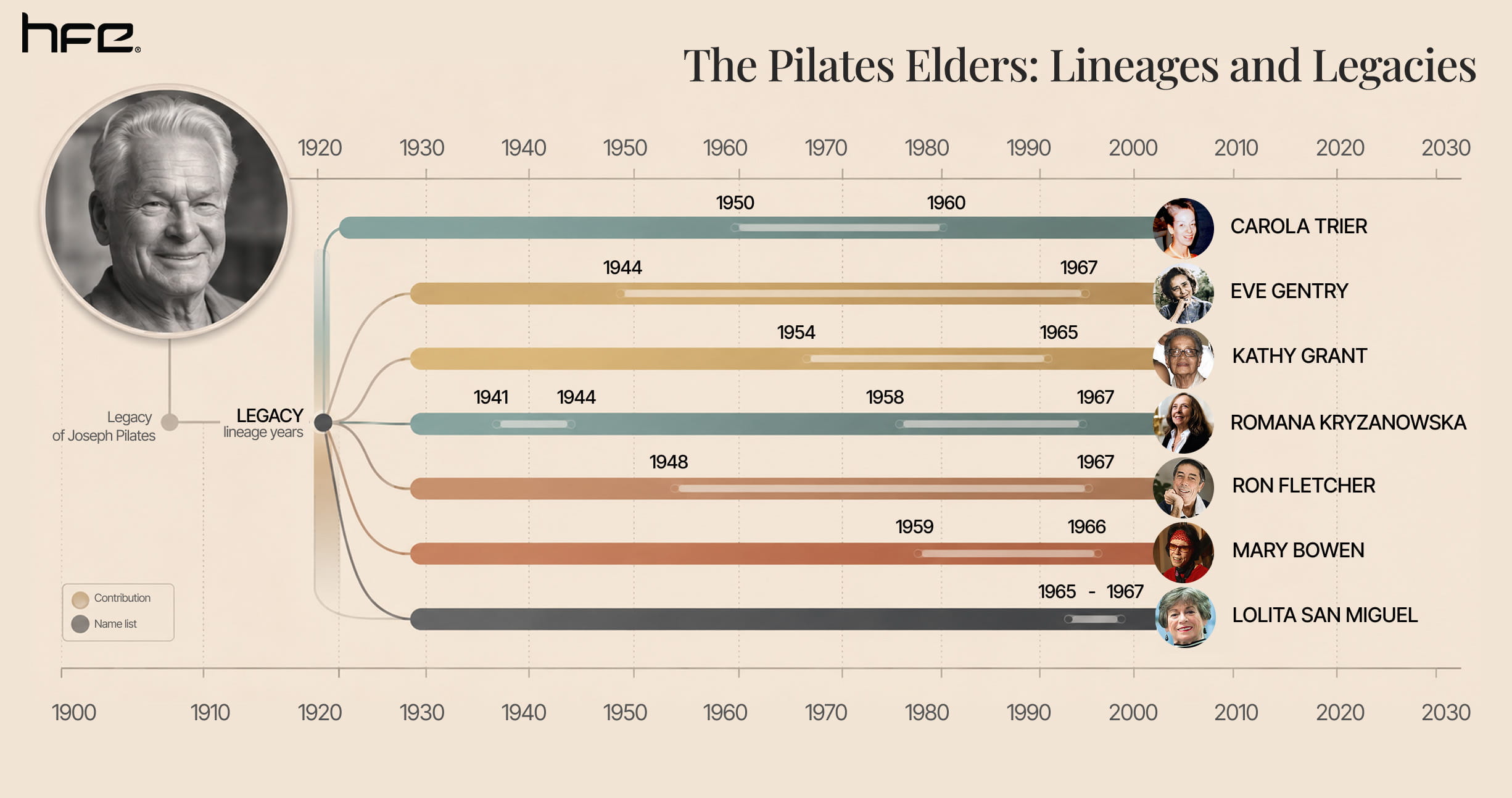
(adapted from Pilates Anytime Infographic, 2026).
The two largest international schools currently delivering global training of ‘classical’ Pilates are the New York Pilates Studio (Sean Gallagher and Elaine Ewing) and Romana’s International Pilates (delivered by several global training centres).
The New York Pilates Studio teacher training programme was the first formal Pilates certification programme. It was created around 1993 by Romana Kryzanowska and Sean Gallagher and this continues to be one of the most renowned and sought-after classical training programmes globally.
Around 2003, Romana created her own formal certification programme known as ‘Romana’s Pilates’, which is now delivered internationally by her daughter Sari Mejia Santo, her granddaughter Daria Price and several other second-generation teachers, trained directly by Romana.
To share some history, Romana managed the New York studio with Clara after Joseph died. She is widely considered by many to be the elder who has most closely preserved Joseph Pilates’ original style and sequencing.
Sean Gallagher is currently the owner of the New York Pilates Studio and the Pilates Archives. He has access to many of Joseph Pilates’ original documents, exercise sequence photographs and apparatus blueprints, all of which are believed to have been discovered at Jacob’s Pillow (a country house in Becket, Massachusetts, that Joseph Pilates previously owned and which is now owned by Sean Gallagher). Jacob’s Pillow is now home to a Pilates Museum that was founded, created and owned by Sean Gallagher (Pilatesology, 2016).
Other Classical Pilates schools include Classical Pilates UK, Peak Pilates, The Pilates Standard, and Vintage Pilates (founded by Jay Grimes). Each school has its own lineage that can be traced back to a specific Pilates elder. Lolita San Miguel, one of the first-generation elders, is also reported to continue her teaching by travelling and running training programmes around the world.
One significant feature that differentiates Classical Pilates teacher training from all other approaches is the model that is used to train teachers.
In order to enrol on a Classical Pilates teacher training course, students are required to complete a minimum of 75 hours of private sessions with a certified classical teacher. This is usually one of the teachers, or senior teachers within the specific Pilates school that will be delivering the training. Some schools also require prospective students to complete a 1-hour practical assessment performing both the intermediate reformer and mat repertoires within one hour.
Once enrolled, students then complete their formal training, most of which is face-to-face. Training also requires extensive private lessons and personal practice, observation hours where trainee teachers shadow other classical teachers, as well as a log of their own teaching practice hours across all apparatus (using the full system). All of this must be completed before any final practical assessment is even contemplated.
On completion of their basic training, Classical Pilates teachers are also expected to continue their learning by working with other classically trained teachers who have a closer lineage (e.g., a third-generation teacher would seek out mentoring and support from a second-generation teacher).
My Pilates journey began around 2000, and I have completed several Pilates training courses over the years with many different schools. While most of these have been modern and contemporary schools, I wouldn’t change one single part of that journey.
Over the last few years, I found myself becoming increasingly interested and curious about the classical approach. I wanted to know more, so I started having private lessons in 2025 with a third-generation teacher who trained with the New York Pilates Studio. It was unlike any of the Pilates I have experienced before, and I loved it!
My original intention was to have maybe one session a month, but this quickly evolved to having weekly sessions which I have attended for the last year. I have more recently enrolled and completed a foundation study programme, the first steps towards a fully comprehensive teacher training programme with a classical school. I have also been reading as many books as I could get my hands on. For me, the best learning has been the one-to-one sessions because this has helped me to make some deeper connections of the work in my own body.
After 26 years, I accept there is still much to learn, and am enjoying and embracing this in equal measures. I have also found that I am really good at cheating in some of the exercises, although my teacher doesn’t let me get away with that.Debbie LawrencePilates teacher, fitness professional and published author.
One of the first Classical Pilates studios in London is ‘New York Pilates London’ run by Daphne Pena-Higgs who was certified by Romana Kryzanowska in 2000 (Fiasca et al., 2013). Daphne is a highly experienced and highly respected teacher who delivers a mentorship programme as well as a range of continuing professional development (CPD) workshops.
There is also a growing network of classical studios evolving from others who have been taught and certified by various first-generation teachers. Some of these have also created their own teacher training programmes based on their personal and professional experience with Pilates (e.g., Pi, Exhale, Everybody Pilates).
A key factor that differentiates Classical Pilates studios from more contemporary studios is the apparatus used. Classical Pilates studios always use apparatus that follows closely the original dimensions and resistance patterns set out by Joseph Pilates, albeit, the exact dimensions may vary slightly between manufacturers. Classical apparatus will almost always use springs with equal tension, whereas contemporary manufacturers use more springs of differing tensions to make their apparatus more inclusive for different needs and abilities.
Some common Classical Pilates manufacturers include, but are not limited to, Gratz Pilates (USA – the original manufacturer, who have recently created an archival reformer), Legacy Pilates Apparatus (Turkey), Pilates Lineage (USA), Pilates Scandinavia, Arregon Pilates (Spain), Techno Pilates (Italy) and Pilates Designs (USA).
Classical Pilates is much more than exercises performed on the mat or reformer. It is a comprehensive and integrated movement system that is built on the foundations of Joseph Pilates’ original and pioneering work. Sharing lineage and philosophy, it is rooted in a rich tapestry of history and tradition, respecting the original goals and objectives.
Every exercise in the classical system builds upon an earlier exercise using a variety of apparatus, creating a natural and logical path of progression from which students can build whole-body strength. Exercises are performed from the inside out, working from the powerhouse of the body. As a system, it works!
To conclude this article, we share a quote from Amy Taylor Alpers (2025).
‘To me the classical Pilates method is this – a complete, integrated whole – a bio-tensegrity method! It’s an organically evolved, uniquely designed collection of whole-body exercises using specialized apparatus, all held together by a powerful organizing force – its philosophy. Change any one aspect of this singular entity and you dissipate its integrity and power. It was developed over decades of exploration and creativity, by a singular mind, to achieve a particular result – full body health through complete coordination of body, mind, and spirit’.
If you enjoyed this article and you want to learn more about Pilates, check out our range of Pilates articles and career guides. If you’re feeling inspired and would like to become a Pilates teacher, you may wish to look at our range of industry-leading Pilates instructor courses. We have a range of matwork, tower and reformer Pilates courses to students that are passionate about keeping the Pilates legacy alive.
Alpers, A.T. (2025). What is the Classical Pilates Method? [online] The Pilates Journal. Available at: https://pilatesjournal.com/articles/what-is-the-classical-pilates-method [Accessed 10 Aug. 2026].
Elaine Ewing’s Pilates History Research ArchiveTM – Rhinebeck Pilates. (2024). [online] Rhinebeck Pilates. Available at: https://www.rhinebeckpilates.com/pilates-history-research-archive/ [Accessed 10 Aug. 2026].
Fiasca, P. (2009) Discovering Pure Classical Pilates. USA: ClassicalPilates.net.
Fiasca, P. et al. (2013) Voices of Classical Pilates – Collected Essays. USA: ClassicalPilates.net.
Fiasca, P. et al. (2017) Voices of Classical Pilates II – Men’s Work. USA: ClassicalPilates.net.
Gratz Pilates (2025). Why Classical Pilates? The Unique Benefits That Set It Apart. [online] GratzTM Pilates. Available at: https://www.gratzpilates.com/blogs/pilates-resources/why-classical-pilates-the-unique-benefits-that-set-it-apart [Accessed 10 Aug. 2026].
Howard Steel, J. (2020) Caged Lion. Joseph Pilates and his Legacy. USA: Last Leaf Publications.
Lewitt, M.S. and McPherson, L.A. (2024) Pilates in 2024: Useful Clinical Tool or Commercial Catchphrase? Accessed on 23/06/2025; available from: https://www.heraldopenaccess.us/openaccess/pilates-in-2024-useful-clinical-tool-or-commercial-catchphrase
Pilates, J. and Miller, W.J. (1945) Return to life through Contrology. USA: J.J. Augustin. Republished in 1998, USA: Presentation Dynamics.
Pilates, J. (1934) Your health. USA: Joseph H. Pilates. Republished in 1998–2008, USA: Presentation Dynamics.
Pilatesteacherassociation.org. (2024). History – Pilates Teacher Association. [online] Available at: https://www.pilatesteacherassociation.org/history/ [Accessed 10 Aug. 2026].
Pilatesology (2016). Joseph Pilates House and Studio in Becket Massachusetts. [online] Pilatesology. Available at: https://pilatesology.com/classes/joseph-pilates-home-in-becket-ma/ [Accessed 10 Aug. 2026].
Pilatesology (2016). Joe Pilates Home and Studio in Becket Massachusetts. [online] Pilatesology. Available at: https://pilatesology.com/classes/joe-pilates-home-in-becket-ma-p2/ [Accessed 10 Aug. 2026].
Pilatesology (2023). The Classical Method of Pilates: Why It’s the Gold Standard. [online] Pilatesology. Available at: https://pilatesology.com/2023/03/the-classical-method-of-pilates-why-its-the-gold-standard/ [Accessed 10 Aug. 2026].
Pilatesology (2026). Did someone say Classical Pilates Sequence? [online] Pilatesology. Available at: https://pilatesology.com/2026/04/did-someone-say-classical-pilates-sequence/ [Accessed 10 Aug. 2026].
Rincke, E. (2019) Joseph Pilates. A Biography by Eva Rincke. USA: Inner Strength Publishing.
Ross-Nash, K. (2015) The Red Thread: The Integrated System and Variations of Pilates – The Mat. USA: Kathryn Ross-Nash New York Pilates.
Siler, B. (2025) The Pilates Body. USA: Harmony Books.
Strack, C. (2024) Get to Know Joseph Pilates. USA: Pilates Projects.

Debbie is a highly experienced writer and consultant in the exercise and fitness industry with over 40 years’ experience. She holds a master’s degree in education and is the author of 13 books published by Bloomsbury Publishing. Additionally, Debbie has also ghost-written numerous training resources and educational products, including many of those used here at HFE. Debbie's goal is to be a continual 'seeker of knowledge’, always reflective and always learning, striving to inspire others to remain curious and open to learning and developing more. Debbie still finds time to teach classes to the public, working primarily with adults who have long-term health conditions.
Step inside the world of Pilates
Great news, you're on the list...