
Sports Massage for Sciatica
A guide for massage therapists exploring sciatica, common causes of posterior leg pain, assessment considerations, red flags, and massage therapy.
A guide for massage therapists exploring sciatica, common causes of posterior leg pain, assessment considerations, red flags, and massage therapy.
When people experience pain that travels from the lower back into the buttock and down one leg, they may search for treatments like sciatica and massage. However, sciatica is not a diagnosis in itself; it describes a pattern of symptoms rather than identifying the underlying cause of pain. Understanding the anatomy of the sciatic nerve and the possible sources of symptoms is important when considering the most appropriate treatment approach for individual clients.
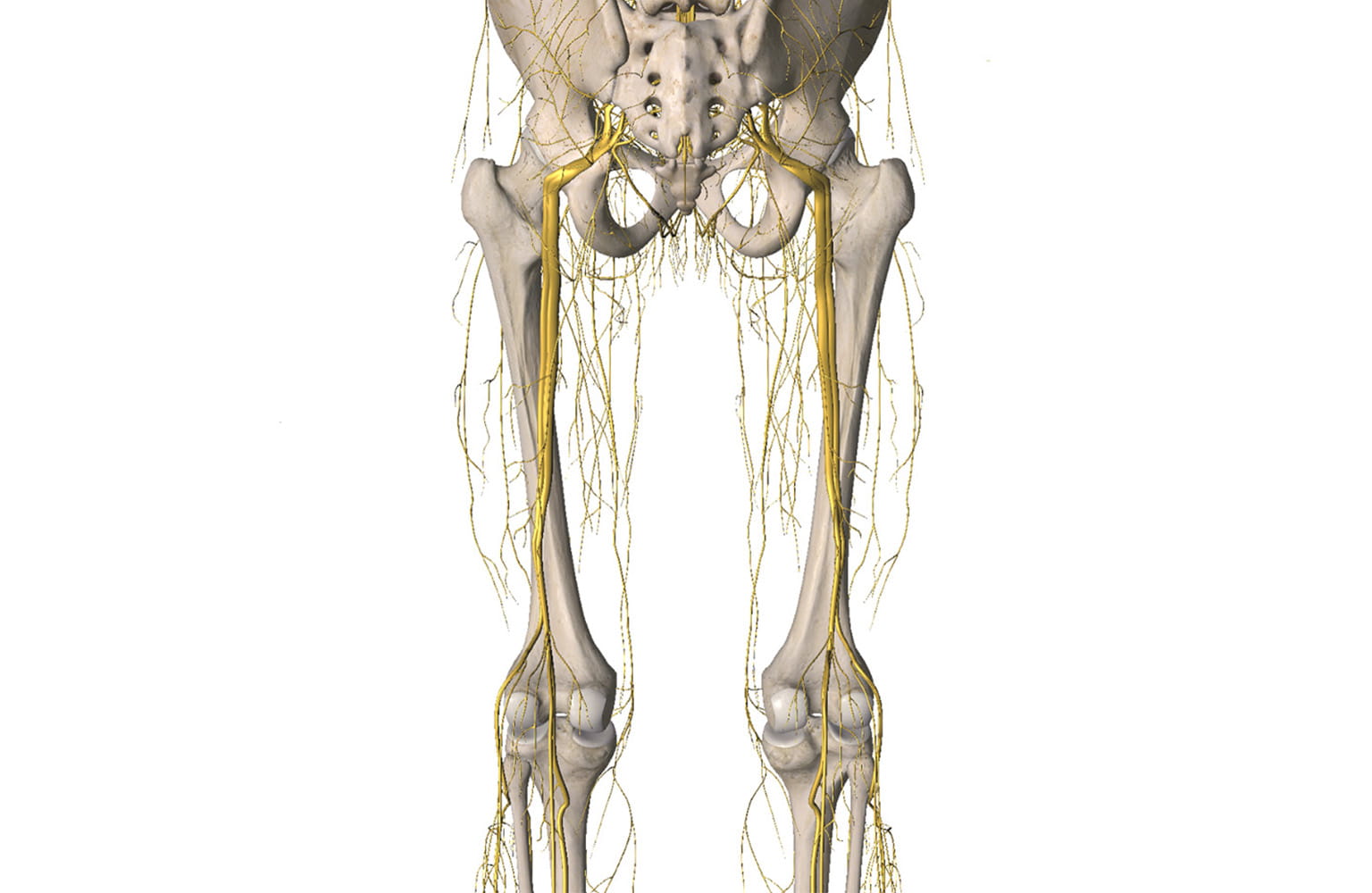
The sciatic nerve is the largest peripheral nerve in the body, measuring up to 2cm in diameter. It is formed from five spinal nerve roots, which exit the spine between L4-S3. They then merge together in the pelvis to create the sciatic nerve. The nerve descends below the gluteal muscles and down the back of the thigh before dividing into two main branches approximately two-thirds of the way down the upper leg. One branch becomes the common peroneal nerve, which runs down the outside of the shin, while the other becomes the tibial nerve, which runs down the back of the shin. Both branches continue into the foot.
Because pain in the buttock and posterior leg can follow the pathway of the sciatic nerve (referred pain), it is common for clients to assume they have sciatica. However, similar symptoms can also be caused by other structures in the low back, irritation of spinal nerve roots, referred pain from the spinal joints, muscle-related pain, especially from the piriformis muscle, as well as other surrounding tissues. For sports massage therapists, understanding these different potential sources of pain is essential when assessing clients and determining whether sports massage therapy is appropriate, and what treatment protocol should be followed.
A spinal disc bulge or protrusion, sometimes incorrectly described as a ‘slipped disc’ or ‘herniated disc’, is one of the most common causes of posterior leg pain. When a disc is loaded unevenly, especially with flexed postures, it bulges posteriorly (to the back), irritating the nerve root(s) as they exit the spine. This can cause pain and other sensations that can radiate down the leg and even into the foot. The most common area in the spine for a disc herniation to present is L5/S1. If a disc irritates or mildly compresses the L5/S1 nerve root, it can cause pain in the same distribution as the sciatic nerve.
Sciatic symptoms associated with a disc herniation often have a sudden onset and develop without a clear cause. Clients will typically describe searing pain that is brought on by a fairly innocuous movement such as picking something up off the floor. Clients often don’t experience pain in the back, only in the buttock and leg. Some people even attend accident and emergency because the pain is so severe, they assume that they have broken or seriously injured something. Intense pain and spasms can last weeks or months, depending on the severity of the disc protrusion. Unfortunately, many people have repeated episodes of pain over time.
Stiffness or trauma affecting the facet joints in the spine can lead to referred pain into the buttocks or down the leg. These clients often experience pain in lumbar region of the spine during extension movements, or when standing for long periods of time. They generally respond well to manual therapy that focuses on the soft tissue around the facet joints, as well as the release of the back extensors and hip flexor muscle groups. Specific and advanced sports massage techniques, like myofascial release for example, can be particularly effective at decompressing the facet joints.
Clients with facet joint dysfunction usually have an anteriorly tilted pelvis which accentuates their lumbar lordosis. This is where the crushing-like pressure in the facet joints comes from. The exaggerated lordosis is typically caused by a combination of tight back extensors and weak lower abdominal and external oblique muscles. Strengthening the abdominals while releasing and lengthening the back extensors is the most optimum treatment protocol sports massage therapists can take.
Tension in the quadratus lumborum and paraspinal muscles can refer pain into the gluteal region (via the thoracolumbar fascia), and the gluteal and piriformis muscles can refer pain into the leg and calf. Again, this runs in a similar distribution to the sciatic nerve and can often be confused with pain arising from the sciatic nerve. To determine whether clients are affected by myofascial pain, sports massage therapists can apply pressure to the gluteal and quadrates lumborum muscles to establish the presence of trigger points, which often replicate the client’s pain. This can be particularly satisfying for both the therapist and client because you have found ‘the spot’ or ‘source’ of the issue. Symptoms can often improve significantly within a single session.
Hamstring strains are often easier to diagnose than other conditions because there is normally a clear mechanism of injury, such as a muscle ‘pull’ when running or kicking quickly. Given the hamstring crosses the knee and the hip, and at the hip it attaches deep to the gluteal, the most effective way to rule out (or in) a hamstring injury is to perform resisted knee flexion, and then hip extension. If the client’s symptoms are reproduced, the source of the pain in the rear of the upper leg or gluteal region is likely to be one or more of the hamstring muscles.
Of course, sometimes the sciatic nerve is the direct cause of posterior buttock and thigh pain. Irritation or damage to the sciatic nerve can be caused by a number of different mechanisms. These include, direct trauma to the nerve caused by an impact injury such as a fall (or a sporting injury, like a tackle), mild compression from surrounding muscles and fascia, and ischemia of the nerve from persistent tightness in the gluteal and piriformis muscles (restricting blood flow).
As a massage therapist, it is not necessarily your role to diagnose the cause of a client’s leg pain, but understanding that the issue could be coming from a number of different sources can help you manage client’s expectations and select the most appropriate type of massage therapy to use.
It is essential to screen clients for red flag symptoms before any hands-on assessment or treatment is performed. Acute disc protrusions can significantly compress the nerve roots as they exit the spine causing a host of complex symptoms. Persistent compression can alter nerve functioning permanently if the pressure on the nerve root is not removed or decompressed. Compression of the exiting nerve roots at the base of the spine is a severe medical condition called Cauda Equina Syndrome. This is an urgent medical condition that requires immediate decompression surgery. If any sports massage therapist suspects Cauda Equina Syndrome, they should signpost their client immediately to Accident and Emergency for assessment.
Therapists should always screen for the following:
Cauda equina is rare, and thankfully I have never seen a client with this. However, remaining mindful of these issues is critical, and could save a person from serious and permanent damage.
In rare cases, persistent leg and/or back pain could be caused by a spinal tumour, or pain referred from one of the internal organs. Clients will often report pain that doesn’t change with movement or rest, pain at night or persistent unremitting pain. They may have a previous history of cancer. To understand the nature of a client’s pain and ensure you have screened for red flags, always take a thorough subjective history.
The success of massage therapy for sciatic pain, or persistent buttock and leg pain, depends on the cause of the pain. Because the causes can be varied, it’s difficult to critically evaluate the evidence for massage therapy and sciatica. That said, many clients do report that they feel better, albeit temporarily, following treatment.
Where we do have more robust evidence is in the research for massage therapy and non-specific low back pain. Cochrane Systematic Reviews form part of the gold standard of research. These reviews collate evidence from randomised controlled trials to ascertain the effectiveness of different therapeutic interventions. A Cochrane review from 2015 found that massage therapy provided significant short-term improvement in pain and function. However, when used as a stand-alone treatment, the long-term improvements at 6-12 months were minimal. Other systematic reviews had similar findings, with massage therapy providing short-term benefits. (Kumar et al, 2013). For long-term benefits, massage therapy should be coupled with physiotherapy or exercise intervention to establish long-term symptom improvement (Preyde, 2000).
In the early phases of acute back and leg pain, massage can be a lifeline for some clients. It alleviates muscle spasm and can down-regulate the nervous system, ensuring that they can sleep more comfortably (enhancing recovery) and move more freely (encouraging normal movement patterns as early as possible). Without massage, clients face longer acute pain phases, a slower return to function, and a potential decline in mental health. Massage provides relief and a coping mechanism at a time when clients are struggling the most. If massage is combined with gentle movement, stretches and a gradual return to normal movement patterns and loading, it can greatly accelerate improvement.
Unfortunately, in the cases of acute disc protrusions, massage may not help at all. Clients often require prescribed painkillers and muscle relaxants to tackle the muscle spasm and guarding. Once the pain and spasm are under control, these clients may then be appropriate for massage therapy. To reduce the incidence of future episodes, I would recommend that clients see a physiotherapist for long-term management programmes.
In the case of chronic disc-related leg pain, massage could be used as part of a long-term management plan to give clients relief and help stop muscle tension building over time. Clients may come once a week or once a month, particularly if they sit for long periods of time for work, or exercise intensively.
Sciatica is typically over-diagnosed, and its use as a diagnosis overlooks the possible underlying pathology causing buttock and leg pain. Sciatica massage can often alleviate pain short-term but should not be used in isolation, particularly in cases where symptoms are not improving, or are considered chronic. If a client’s symptoms persist or worsen with massage therapy, it is advisable for them to see their GP or a physiotherapist to ascertain the exact cause of the pain.
Developing this clinical reasoning and assessment knowledge is an important part of becoming a confident sports massage therapist, and our Sports Massage Courses cover the techniques, assessment skills and practical knowledge therapists need to work safely and effectively with clients.

Leanne is a Specialist Pelvic Health and Musculoskeletal Physiotherapist with over 17 years of experience. She has worked in the NHS and in private practices across London. She was the Service Lead for a large private company before moving to Bangkok to focus on physiotherapy education.
And discover more about the world of massage therapy
Great news, you're on the list...