
Yoga teaching and practice
A guide to Ashtanga yoga for yoga teachers and trainees, exploring its origins, practice, benefits and misconceptions.
A guide to Ashtanga yoga for yoga teachers and trainees, exploring its origins, practice, benefits and misconceptions.
Ashtanga yoga is a structured practice of a series of poses coordinated with breath to create continuous and flowing set sequences.
In Sanskrit, the word ashtanga can be divided into two: ‘ashta’ meaning eight, and ‘anga’ meaning limbs. Each practice is intended to bring together all eight limbs of yoga, as described in the important ancient yoga text, the ‘Yoga Sutras of Patanjali’.
Particular emphasis is given to three of the eight limbs: pranayama (breath control), asana (poses) and dhyana (meditation).
While the sequences within the series of poses are dynamic and physically demanding, the purpose of the practice is to promote mental clarity and inner calm.
Ashtanga yoga has its roots in India, with the teachings of Krishnamacharya. He is sometimes described as the ‘father of modern-day yoga’, because he took what had become a physically static daily practice to something more dynamic. Krishnamacharya was an Ayurvedic doctor, who believed in the healing benefit of a practice that addressed the whole person, including spiritual and physical aspects.
Jois was a student of Krishnamacharya from 1927 to 1953. He further developed the system he had learnt, combining it with his own studies, to create the structured system of Ashtanga yoga as it is practised today. Of particular note is his addition of sun salutations, which had not been included by Krishnamacharya, but were being practised as a form of exercise in a nearby hall.
In 1948, Jois established the Ashtanga Yoga Research Institute at his home. The institute is still open, in the city of Mysore. Following visits to the institute by Westerners (Europeans and Americans), Jois was invited to deliver lectures and seminars outside of India, introducing Ashtanga yoga to a new and wider audience.
There are six different set sequences of Ashtanga yoga, known as the six series: Primary, Secondary, and four Advanced Series. They all follow the same structure:
The word mantra comes from Sanskrit; manas meaning mind, and tra meaning tool. A mantra is any sound, word or short phrase that, when repeated, aids concentration and a calmer state. Typically, the word ‘om’, believed to be a sacred sound, is repeated three times as a minimum.
In Sanskrit, surya means sun, and namaskar means ‘I bow to you’, or salute.
There are two distinct sun salutation sequences that form Surya Namaskar A and Surya Namaskar B, both involving poses that transition through forward bends and backbends, from standing to lying on the mat, to standing again. The sun salutations remain consistent throughout all series.
This includes 71 to 75 poses, taking 60 to 90 minutes.
Known as the Yoga Chikitsa (yoga therapy) Series, this is the foundation series, intended to heal. It focuses on becoming familiar with asana, pranayama, and also drishti (the gaze point) as a tool for building concentration and a meditative mind.
The poses are foundational, intended to improve the sense of connection with the earth, with forward bending, back bending, hip opening, and core strength.
This includes 55 poses, taking 75 to 120 minutes.
Known as the Nadi Shodhana (nadi means channel or tube, shodhana means cleansing or purification) Series, intended to cleanse the energy channels/nervous system. It focuses on progressing the flexibility and strength introduced in the Primary Series, with deeper variations of the poses.
Many yoga students don’t find it necessary or appropriate to introduce poses from these series because they require advanced flexibility, which not all body types will safely support.
Poses from these series are usually introduced one at a time, as suited to the individual. Together these are known as the Sthira Bhaga Series (meaning divine stability).
The concept behind the repeating of the same sequence is that with regular practice and repetition, there is not only physical progress, but also a deeper spiritual connection within oneself.
Even for those who are disciplined in their practice, progressing from one series to the next may take at least 2 years because of the necessary flexibility and strength required for more advanced variations of the standing and seated poses.
With the Primary and Secondary Sequences being set, regular practice provides the opportunity to progress, and to notice the progression.
Improvements can be achieved in flexibility, muscular strength and muscular endurance, and the cardiovascular system, with benefits transferable to sport and everyday life movement.
Once the sequence becomes familiar, the flowing connection of breath and movement creates a moving meditation that brings about benefits to the nervous system, and a sense of inner calm.
The intention is to be able to practise a sequence without instruction. Then self practice, requiring self discipline, brings about the added benefit of being able to practise anywhere.
Attending a class is important for students to learn the correct technique for each pose, and the correct order of the poses when linked together to form a sequence.
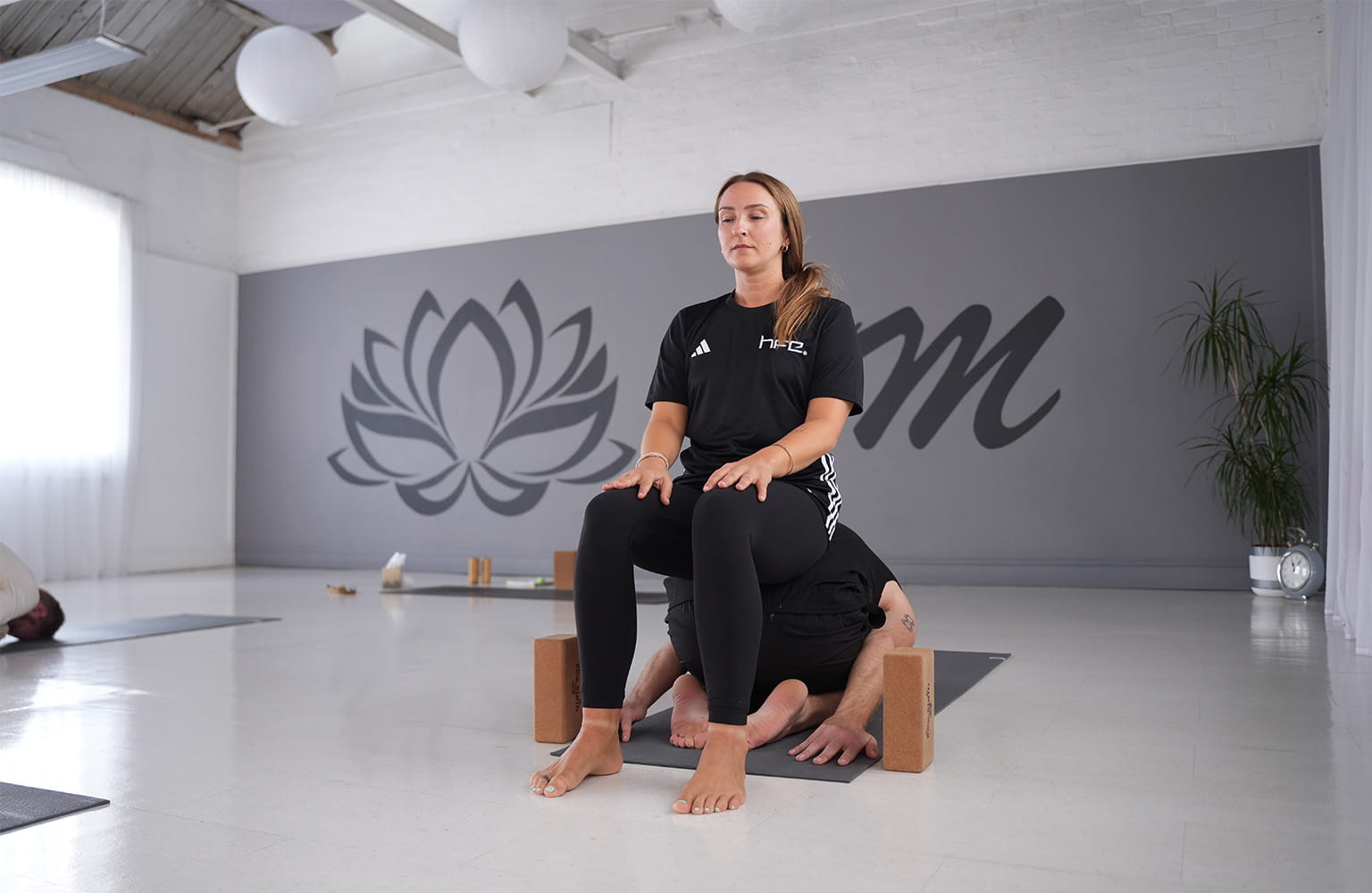
For complete beginners, the Primary Series is taught using what is known as the Mysore approach. Each posture is introduced with detailed instructions by the teacher, who then provides individually adjusted guidance to refine the posture. In this way, time is taken over each pose, and some poses might be omitted in order to focus on the detail of those that are included. The teacher might spend more time with one student and less with another, enabling each student to move along at their own pace.
Once the students are more familiar with the postures, less time is spent refining each, and the teacher’s approach changes, so that they lead the sequence with everyone practising each posture at the same time. All the poses from the series are included, and they are linked together to create a flowing vinyasa.
Most studios that provide a range of yoga classes will include Ashtanga on their programme. The classes are most likely to follow the Primary Series. With the sequence set, no detailed planning of content is required by the teacher, though if time is limited then it may be necessary to decide which poses to leave out.
Both Krishnamacharya and Jois were practising Hindus, but they were open to students of all religions and none. Although the origins of all yoga are built on the teachings of Hinduism, the holistic approach of Ashtanga yoga is not religious, but intended to aid the mindful connection of mind, body and spirit.
It’s the repeated practice of the same sequence that provides the opportunity for achieving a meditative state while moving. The disciplined approach to learning the sequence, repeating the sequence and making small adjustments, is necessary in order to be sufficiently familiar with it. So rather than being boring, it allows for a deeper connection between the physical body and mind.
What makes one Ashtanga class uniquely different from the next is the teacher’s personality and way of explaining each pose.
A beginner’s Primary Series class will be very different in its pace from an advanced Primary Series class. The same will be true for beginner vs advanced classes for any of the series.
Ashtanga is often described as a high energy, high intensity style. However, the original teachings intended for the practice to be suitable for everyone, from low to high fitness levels, with less or greater familiarity with yoga.
A Mysore class will have a slower pace and be adjusted according to the fitness level of the individuals within the class.
Foundational training, such as a Level 3 Yoga Teacher Training course, provides the knowledge and skills required to teach a range of yoga styles. The foundational training introduces all the poses within Primary Series, but not the correct sequence of an Ashtanga series.
Those wishing to specialise in Ashtanga yoga will choose to follow up their foundational training with a continuing professional development course that teaches Primary and possibly Secondary Series sequences, deepening understanding of how to teach using the Mysore approach.
Sara has over 30 years' experience in the health and fitness industry, teaching classes in private and local authority facilities. She enjoys sharing her knowledge and skills in her role as a tutor, assessor and course developer. She has been involved in writing syllabus, manuals and assessments, including as the lead tutor to the Inclusive Fitness Initiative, working with disabled people, and through her work with frail older people. She co-created one of the first Yoga Teacher training courses within the fitness sector, having benefited from her own personal yoga practice.
And embrace the rich and vibrant world of yoga
Great news, you're on the list...