An Introduction to Iyengar Yoga
Explore the history, principles, benefits and teaching approach behind this alignment-focused style of yoga.
Explore the history, principles, benefits and teaching approach behind this alignment-focused style of yoga.
Iyengar yoga is named after Bellur Krishnamachar Sundararaja Iyengar, who is more widely known as BKS Iyengar (1918–2014). Iyengar yoga is a style of hatha yoga and, like other hatha yoga practices, includes physical poses (asana), breathing techniques (pranayama) and, in more modern interpretations, meditation.
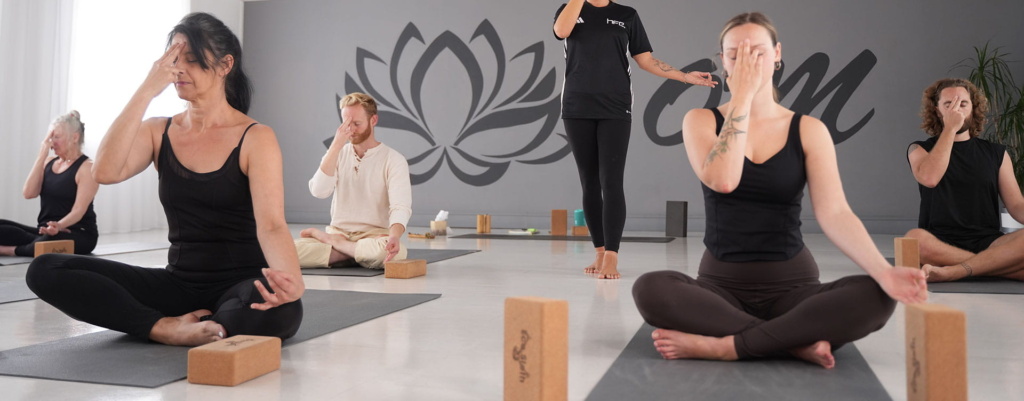
What distinguishes Iyengar yoga from other forms of hatha yoga is its focus on alignment within the poses. The Iyengar approach frequently uses props such as yoga blocks, bolsters, straps and blankets to help students fine-tune their alignment, support balance and build confidence in their practice.
BKS Iyengar experienced many health issues in his early years. His mother had flu while pregnant, which was suspected to be the cause of his low birth weight and subsequent ill health. His family was poor and he was the 11th of 13 children, so there’s a high probability he was severely malnourished as a child.
At that time in India, contagious infections such as tuberculosis, malaria and typhoid were extremely common, and these further exacerbated his poor health. As a teenager, BKS Iyengar was extremely weak, which also led to him being bullied at school.
Aged 15, BKS Iyengar was sent to Mysore, India, to live with his brother-in-law, Tirumalai Krishnamacharya (1888–1989), who was a well-known yoga instructor and Ayurvedic healer. Krishnamacharya’s approach was harsh and forceful, sometimes causing injuries rather than resolving health issues. Aged 18, BKS Iyengar was himself sent off to teach yoga, but he believed there had to be a better way of nurturing weak, unfit or inexperienced students than the approaches used by his brother-in-law.
One area BKS Iyengar decided to focus on was the use of props. He found these particularly helpful for gradually easing his students into basic postures, and then increasing the difficulty over time to make the poses more challenging. Iyengar was driven by a passion to demonstrate that yoga is suitable for everyone – people of all abilities and all ages – as long as it is taught at an appropriate level.
In 1952, the world-famous violinist Yehudi Menuhin was on a tour of India. Having come across a book on yoga while waiting for an osteopath appointment, he asked to be introduced to a yoga teacher. That yoga teacher was BKS Iyengar. Menuhin’s introduction to Iyengar opened up a number of new opportunities for them both. In 1954, Iyengar was invited to Menuhin’s home in Switzerland, where he taught private sessions to Menuhin and others. Thereafter, Menuhin helped Iyengar to take his teachings and philosophy to wider audiences in other countries, including the UK and France.
Following the launch of his international career, BKS Iyengar travelled regularly throughout Europe, the United States, China and Russia. For many years he visited London every summer. Despite his extensive travels, he remained a resident of India, and established the Ramamani Iyengar Memorial Yoga Institute (RIMYI) in Pune, India, in 1975. Ramamani was his wife’s first name. She died suddenly in 1973 when the institute was in the planning stage. Devastated by her loss, he included her name in its title as a memorial to her. The RIMYI is still a global centre of yoga practice and teaching, and a place of study for the Iyengar yoga approach.
Iyengar wrote ‘Light on Yoga’ (1966), a publication often referred to as the ‘bible of modern yoga’. His motivation for writing this groundbreaking yoga text was simple: to spread his teachings even more widely around the world. Naturally, Menuhin, his number one student and follower, wrote the foreword.
Light on Yoga is divided into the following three sections:
Throughout the book, he graded and classified each asana on a scale of 1–60 according to its physical complexity and mental challenge. In the appendix, he provides a 300-week yoga course, which takes students from beginner through to advanced. He grouped the asana to show their suitability for different levels of practice, as shown in the following table:
Level | Rating (0-60) | Descriptor |
Primary course | 1-15 | These were largely basic standing, forward folding and rotation asana. |
Intermediate course | 16-35 | More advanced versions of the primary course, often requiring much higher levels of stability, flexibility and control to perform. This course also included some inversions. |
Advanced course | 36-60 | These were the most advanced asana which required much more strength, flexibility and control to perform. |
Iyengar’s philosophy is clear, in so far as until an easier expression of an asana has been mastered, it would be inappropriate to progress to a harder version. In this way, he was applying a safety mechanism while providing a scale for progression.
My husband attended a yoga convention in the mid-1990s, where he was fortunate to attend a Q&A with a direct student of Iyengar’s. When asked what his favourite asana was, the answer came: ‘Eating and sleeping.’ On their first meeting, when Menuhin was suffering from aches, pains and exhaustion, rather than offering poses or breathing exercises, Iyengar instructed Menuhin to lie on the floor and go to sleep. Iyengar viewed eating and sleeping as the foundational pillars of health and wellbeing, and believed nourishment and rest should always be prioritised.
The Iyengar style of yoga is rooted in a number of core principles, including alignment, props, timing, sequencing and inward focus. These principles are elegantly applied and explained in his book, and are summarised in the paragraphs below.
Alignment refers to the relative position of key joints and limbs, especially the spine. Alignment is important for safety, balance and stability, the flow of energy (known as prana in yoga) and efficiency. Students are frequently influenced by images on the internet, presuming their body has the proportions, strength and flexibility to achieve what they have seen in the media or online. Often these yogic depictions have been staged or photoshopped, or show advanced practitioners, suggesting everyday people can perform these movements. More realistically, we are all made differently, so not everyone has the potential to demonstrate ‘perfection’. What is more important than perfection is the best positioning of bones and joints for the individual, engagement of the muscles to support the position, and the opportunity to connect the mind with the position to experience the feeling.
Thanks to Iyengar and his groundbreaking approach to teaching yoga, props are now commonplace and widely used in most yoga studios. These props include, but are not limited to, the following:
Props are primarily used to reduce the range of movement required to get into a pose, and to provide additional support once in the pose. In this way, optimal alignment can be achieved for each individual, creating safety and comfort while also allowing poses to be held for longer. It also means that the practice is more accessible to a wider range of students of different levels and abilities. In this regard, inclusivity is at the heart of the Iyengar approach, even though he may not have used that word to describe it.
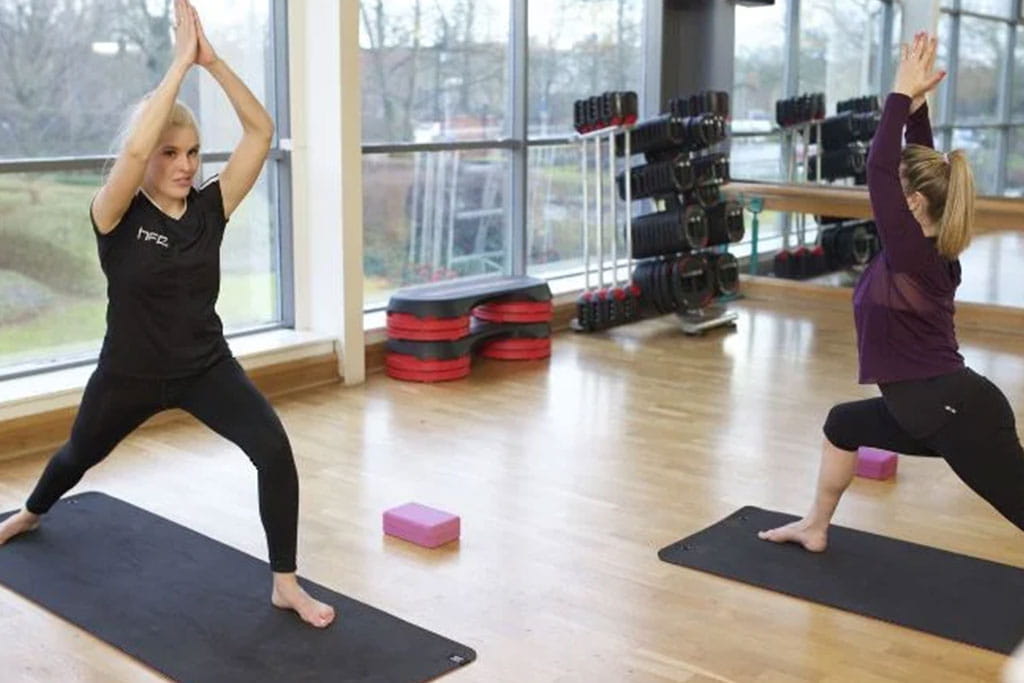
Props may be used by everyone in a yoga class because they are a core part of how that teacher delivers a specific asana. Alternatively, they may be used only by those whom the teacher deems would benefit from an adapted or progressed variation. For some poses only one prop might be used, whereas for others a whole collection of props can be used at the same time to tailor the posture to the individual and their needs.
An Iyengar student can typically expect to spend up to 5 minutes on a single pose, although more experienced students might spend even longer. This is another core feature of the Iyengar yoga approach.
During each asana, a student may be asked to make small or large adjustments. This may involve adjusting the position of their body from the basic sitting, standing or lying position to a more advanced version, or adding props to further improve their alignment. In this regard, students make progress within every single asana, even if it is only a little at a time.
Students are encouraged to ease gradually into and out of each pose, because this also tends to lead to improved results. The longer holding duration allows time for each student to notice their body’s position and make smaller or larger adjustments. This corresponds nicely with the inward focus element of Iyengar’s approach.
Once a student has achieved an optimal position, the pose will often be held further to promote greater flexibility in the target muscles. At the same time, students are encouraged to relax, to build muscular endurance in the muscles being actively engaged, or to enter a meditative state.
Iyengar liked to focus on alignment first, then, as students became familiar with his techniques, he introduced mindful breathing. Through mindful breathing within a posture, the steadiness of the breath is said to calm the nervous system and improve the student’s ability to concentrate on the moment, quietening chitta vritti (mental chatter, or fluctuations of the mind).
As with other styles of hatha yoga, the physical practice is designed to support the mental work, allowing the student to bring about much more of a meditative experience.
An Iyengar sequence follows precise structural principles rooted in alignment, safety and the energetic effects of poses. Each pose prepares the body for the next, with poses that heat the body coming before poses that cool the body.
The typical sequence of a full Iyengar class is as follows:
Many teachers also incorporate yogic philosophy and the deeper, more spiritual aspects of the discipline into their practices to make them more authentic.
As mentioned earlier, BKS Iyengar created a ranking system of the physical and mental difficulty of every one of the 200 poses included in Light on Yoga. This informs much of the Iyengar sequencing approach.
The benefits of Iyengar yoga are broadly the same as those of other hatha yoga styles, in so far as there are physical benefits (e.g., greater mobility, flexibility and strength), mental benefits (e.g., improved mental focus, reduced stress and greater relaxation), and energetic and emotional benefits (e.g., improved mood and better regulation of emotions).
More specifically, Iyengar yoga has the following benefits, which are particular to this yoga style:
To become an Iyengar yoga teacher, it is first necessary to complete one of the many foundational yoga instructor courses. This may be a regulated qualification, such as the Level 3 Diploma in Teaching Yoga, or a 200-hour teacher training programme taught by a dedicated yoga school.
Foundational training covers all elements of any hatha yoga-based practice and is an ideal way to start the Iyengar teacher training journey. It introduces the common poses in their simplest form, their Sanskrit names and the anatomy of each pose. It also gives each student the opportunity to better understand their own body’s expression of these poses. Foundational training also introduces pranayama and philosophy, which are both important elements of an Iyengar class.
Specific Iyengar training then deepens understanding and individual tailoring through the use of props. Foundational training does introduce the hands-on approach to adjustments, but because this is such an important part of teaching Iyengar yoga, more specific training is given within an Iyengar yoga teacher training programme. It is said to take 6–10 years of practice and training to qualify as an Iyengar yoga teacher, so this isn’t usually something people do when they start their yoga teaching careers.
If you enjoyed this article and you want to learn more about different styles of yoga, check out some of our other articles, including hot yoga, kundalini yoga, vinyasa yoga, yin yoga and ashtanga. Each of these articles will give you a holistic overview of the lineage, purpose and benefits of that particular style.
Sara has over 30 years' experience in the health and fitness industry, teaching classes in private and local authority facilities. She enjoys sharing her knowledge and skills in her role as a tutor, assessor and course developer. She has been involved in writing syllabus, manuals and assessments, including as the lead tutor to the Inclusive Fitness Initiative, working with disabled people, and through her work with frail older people. She co-created one of the first Yoga Teacher training courses within the fitness sector, having benefited from her own personal yoga practice.
And embrace the rich and vibrant world of yoga
Great news, you're on the list...